
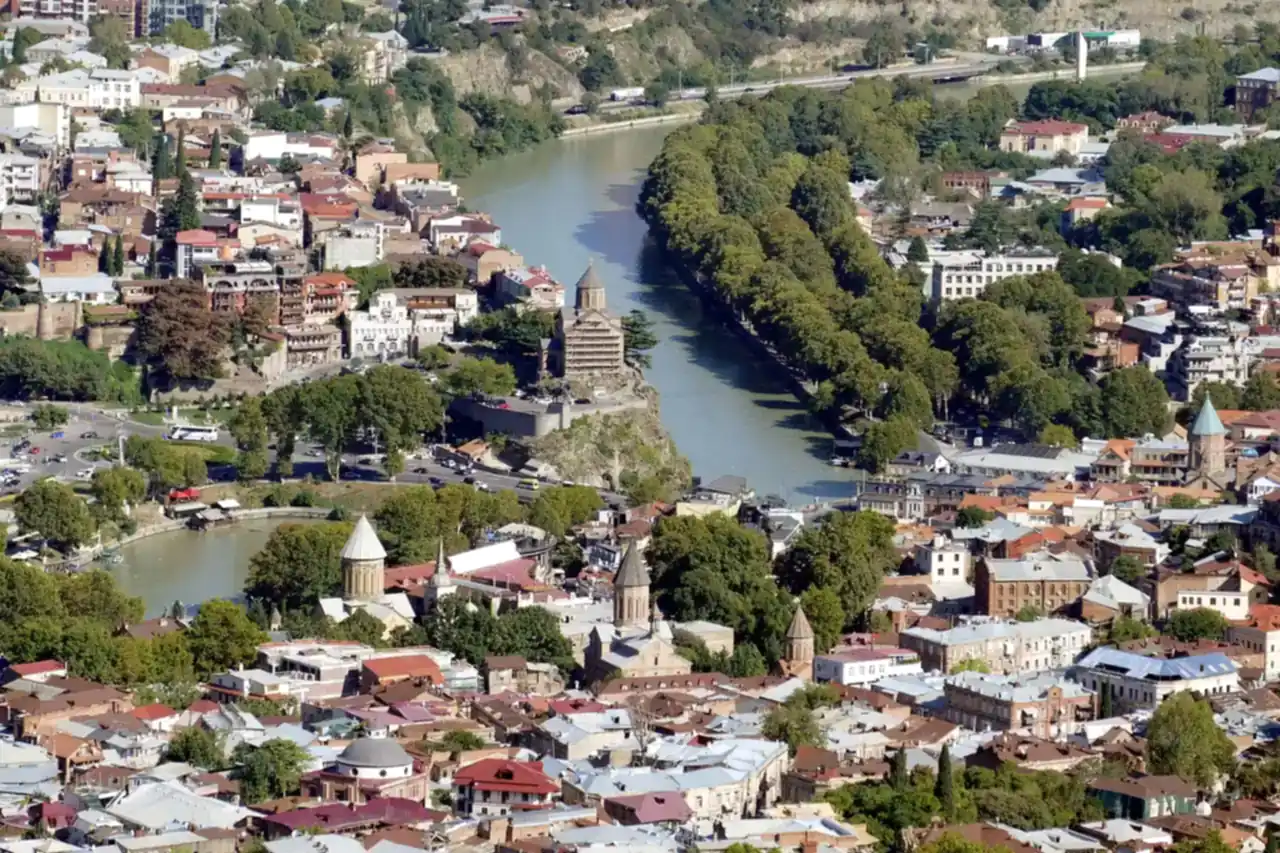
What is the weather in Tbilisi, in one minute?
Tbilisi is a continental city, so the year swings hard: a cold, grey winter, a quick wet spring, a hot clear summer and a mild autumn that turns cold by November. Here is the year:
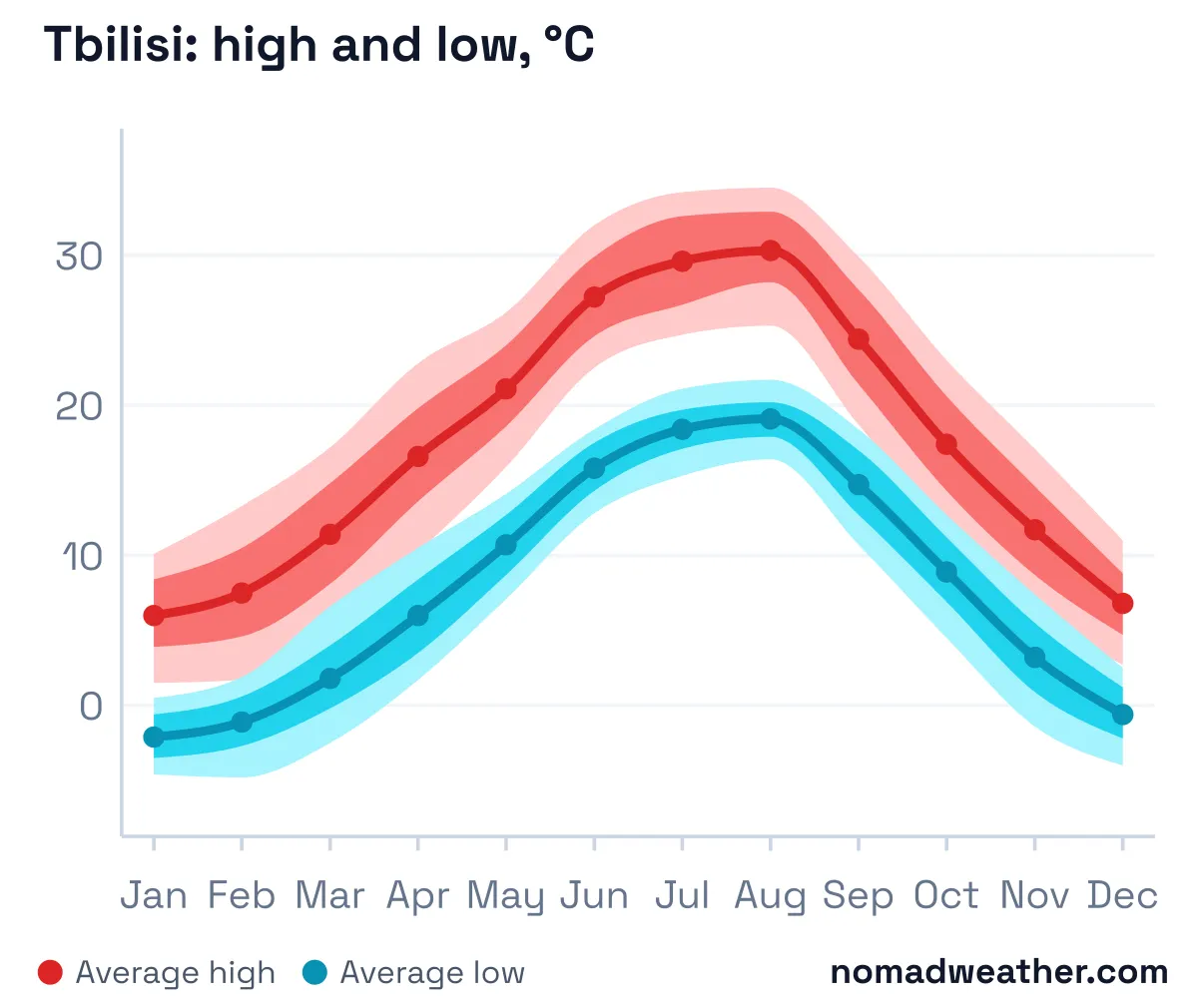
Tbilisi: Average high and low temperature, °C
Tbilisi: Rainfall, mm
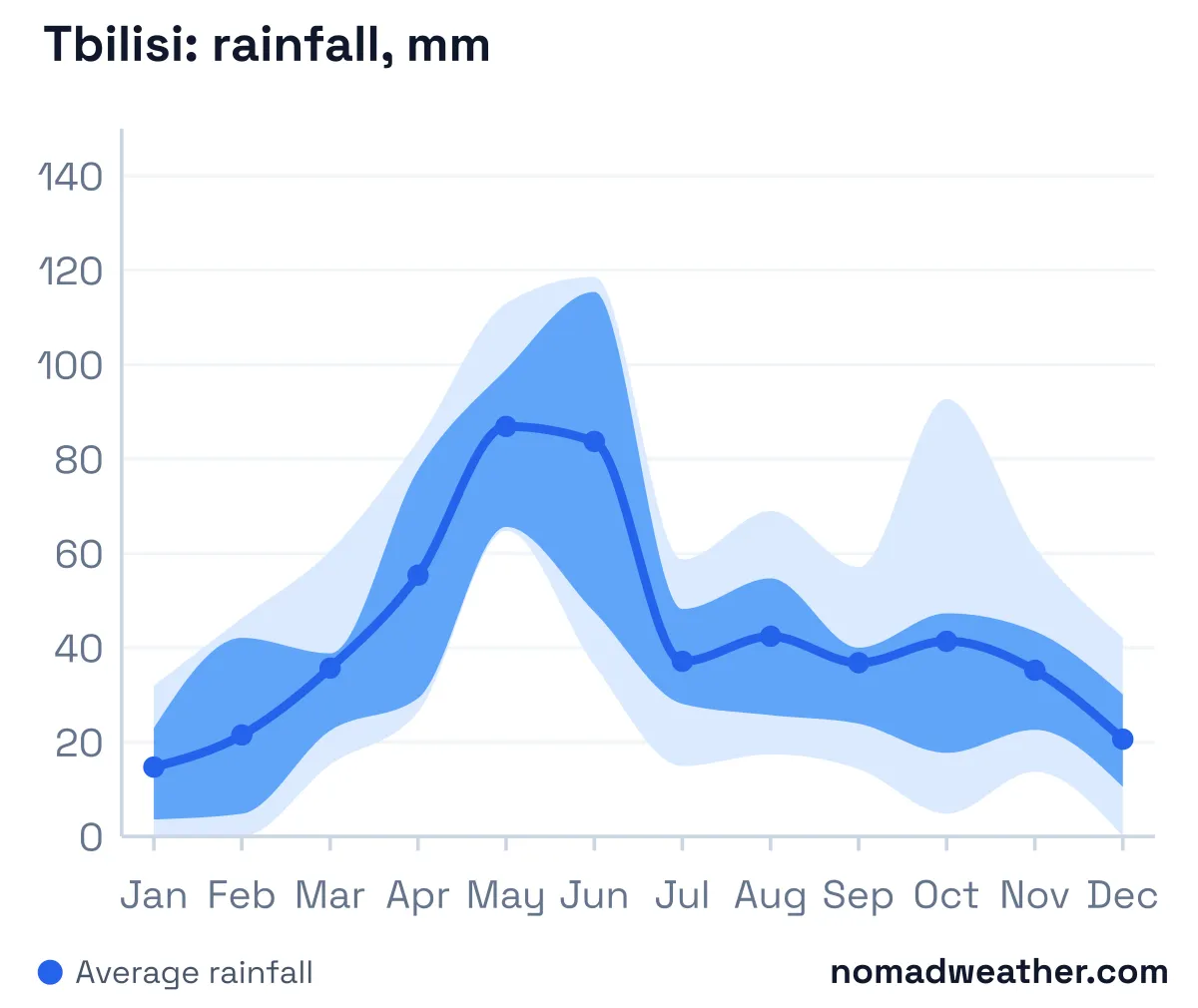
Averages 2015-2025 · Source: Open-Meteo, CHIRPS · How we measure
Read the temperature band first: it goes from highs of 6° in January to 30° in July and August, with nights below freezing from December to February. Then the rain line, which peaks in May and June, not in winter. For a single month, the Tbilisi destination page is quicker.
Where to be next: your month-by-month route, $19
A route for your months with a leave-by date for each stop, a backup, and the seasonal traps on your path. Drafted from 11 years of weather data, every number checked against it, in your inbox within 48 hours. Not included: visas, insurance or bookings.
When is Tbilisi too hot?
July and August. Highs reach 30° in both months, and nights stay at 18° to 19°, so the flat does not cool much after dark. The sky is the clearest of the year, with cloud over about a third of it, and rain is light.
Single days can be well above the monthly average, and the city sits in a basin, so the heat holds. If your flat has no air conditioning, check before you book. The practical answer for a long stay is to come in June, when highs are 27° and nights 16°, or to leave for the mountains in the hottest weeks.
When is Tbilisi cold and grey?
December to February. Highs are 7°, 6° and 8°, and nights fall to -1° or -2°. Rain is low, with 15 mm in January, but more than half the sky is cloud and humidity is 71 to 77 percent. That is what people mean by a grey winter: dry enough to walk about, but cold, and not a place to chase winter sun. It suits people who want a quiet city and do not mind the cold. For warmth, the warmest places in Europe in winter are better matches.
What are spring and autumn like?
Spring is quick and wet. Highs rise from 11° in March to 17° in April and 21° in May, while rain climbs from 36 mm to 55 mm and peaks at 87 mm in May and 84 mm in June. Spring is green, but it is the rainiest stretch of the year, so do not expect a dry April to June.
Autumn is the better season. September has highs of 24° and nights of 15° with only 37 mm of rain. October drops to 17° by day and 9° at night, and by November highs are 12° and nights 3°. For comfort and dry weather, September and early October are the best of the year in our data.
How does the weather change what you pack and book?
Tbilisi asks for two wardrobes. From November to March you need a proper coat, boots and a warm flat, and heating costs are part of the budget, so ask what the building uses and who pays. From June to September you need light clothes, shade and air conditioning. In April, May, October and November pack both layers, because mornings are cold and afternoons mild, and the weather can change inside a week.
Flats in older buildings can be cold in winter and hot in summer, so look at which way the windows face and which floor you will be on. A flat with a balcony in the shade makes July and August much easier; a top-floor flat in the sun does the opposite.
Who should come when, and what would we do?
For a long stay the comfortable months are June, September and October. June is warm but not yet at its peak, though it is also one of the wetter months. September has the best mix of warm days, cool nights and little rain. March and April are fine but changeable and cold in the evenings.
We would come in June, before the heat, and stay into October if you are fine with a hot July and August and have air conditioning. If not, split it: June in the city, July and August in the mountains or somewhere cooler, then back for September and October. Leave by mid-November. If you cannot avoid winter, bring the right coat and expect cloud. Tbilisi fits the summer-to-autumn half of a circuit well; compare it in where is warm in July.
This is a weather view only. It does not cover visas, flights, cost of living or internet quality.
How sure are these numbers?
They are month-of-year averages for a single point near the city, from stored climate data (Open-Meteo, eleven years), so any single year can be hotter, colder or wetter. The hills around the city are cooler and the centre can feel warmer than the average. A rainy day here is a day with at least two millimetres of rain, which matches what rain gauges count.
Frequently asked questions
What is the best month to visit Tbilisi?
September and October are the easiest, with warm days, cool nights and little rain. June is the warm alternative, with highs of 27°C and nights of 16°C, but it is one of the wetter months. September has highs of 24°C and nights of 15°C.
How hot does Tbilisi get in summer?
August is the hottest month in our data, with an average high of 30°C and nights of 19°C. July is almost the same, at 30°C by day and 18°C at night. Single days run hotter than the monthly average.
How cold is Tbilisi in winter?
December and January have highs of 7°C and 6°C and nights just below freezing, at -1°C and -2°C. February is similar. Cloud cover is higher than in summer, so it often feels grey.
When is the rainy season in Tbilisi?
Late spring. May is the wettest month at 87 mm and June is close at 84 mm. January is the driest, at 15 mm.
Is Tbilisi good for a winter stay?
Only if you are fine with cold. Highs stay at 6°C to 8°C from December to February and the sky is cloudier than in the summer months. If you want warm weather in winter, look elsewhere.
Not sure where yet? Pick your months and what to avoid, and get your 3 best places → Where should I go?
Weather data: Open-Meteo (CC BY 4.0), open-meteo.com; rain totals: CHIRPS (Climate Hazards Center, UC Santa Barbara). Processed by NomadWeather from stored copies of the data.