
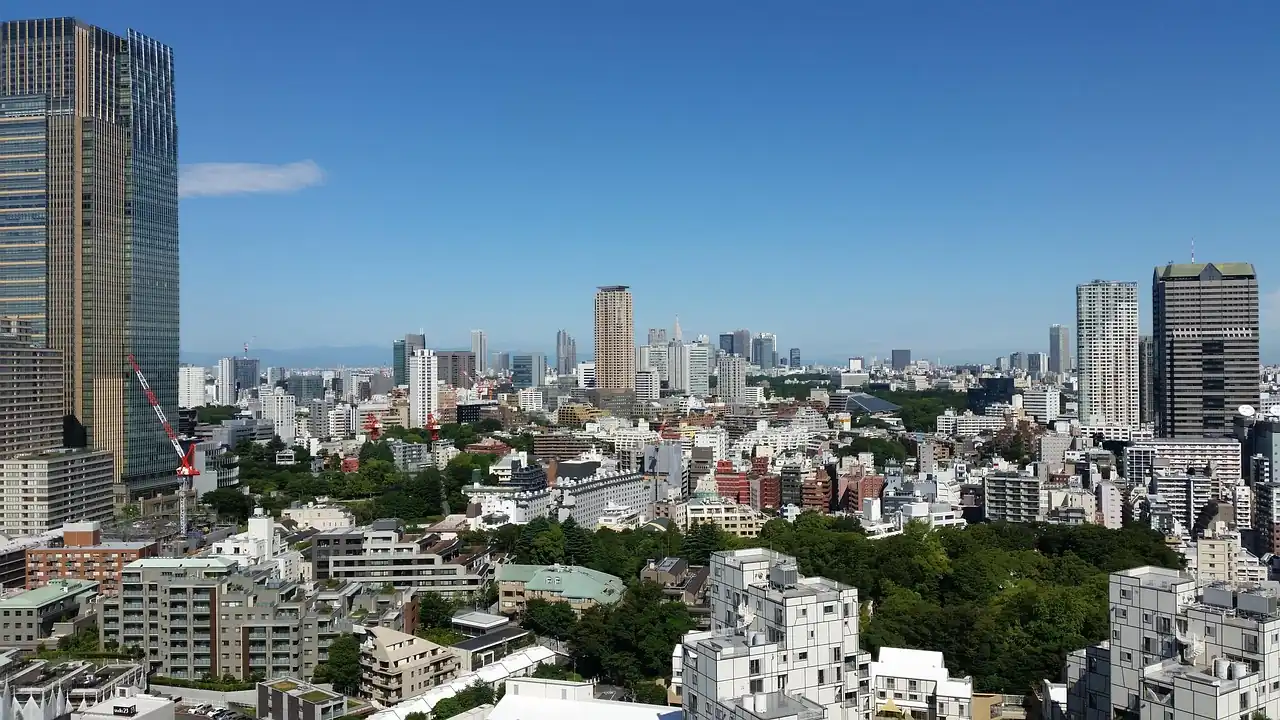
What is the weather in Tokyo, in one minute?
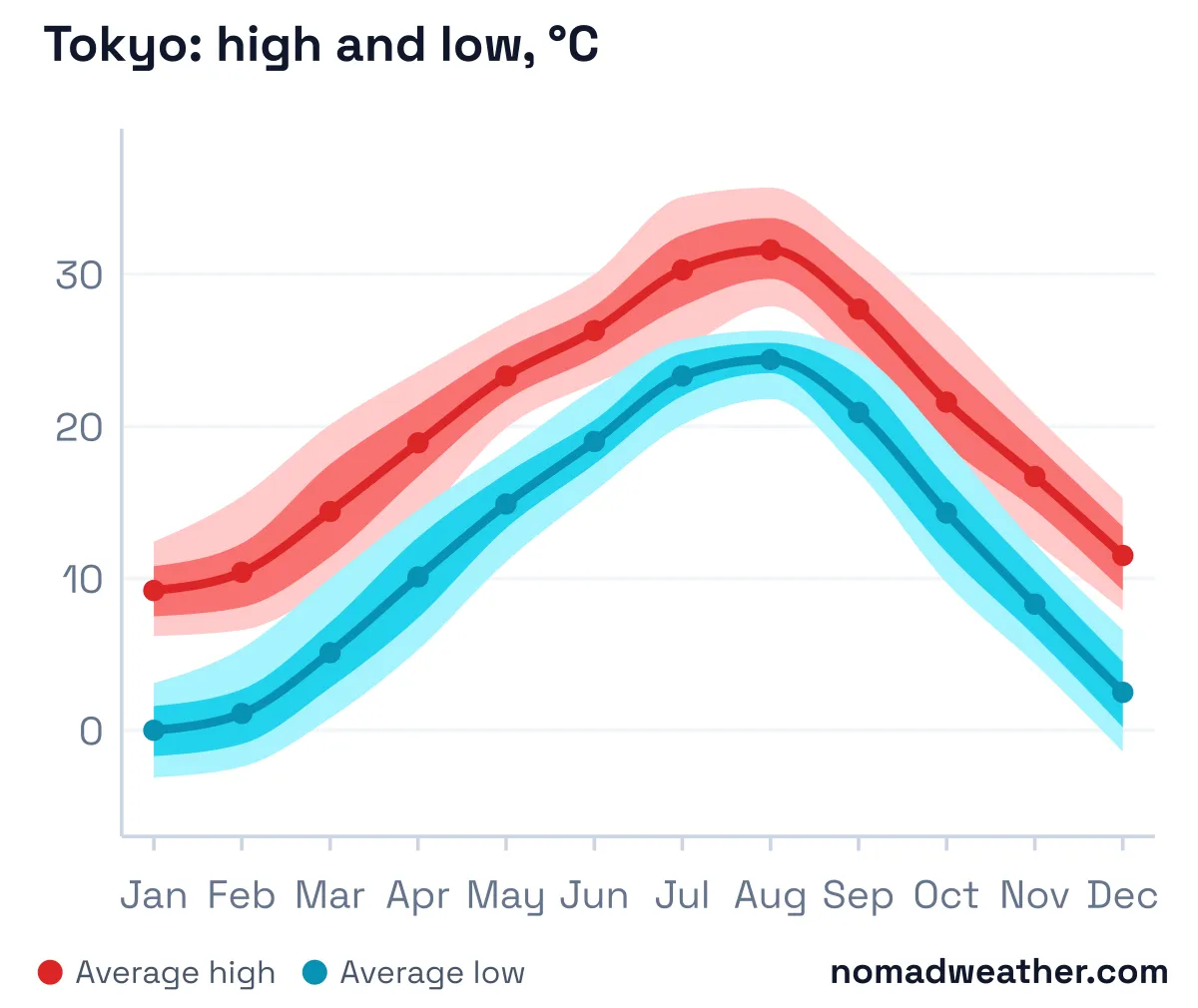
Tokyo has four clear shapes in our data. Winter is cold and bright, spring warms up but stays damp, summer is the rainy season and the heat together, and autumn starts as the wettest part of the year and turns clear in November. Here is the whole year:
Tokyo: Average high and low temperature, °C
Tokyo: Rainfall, mm
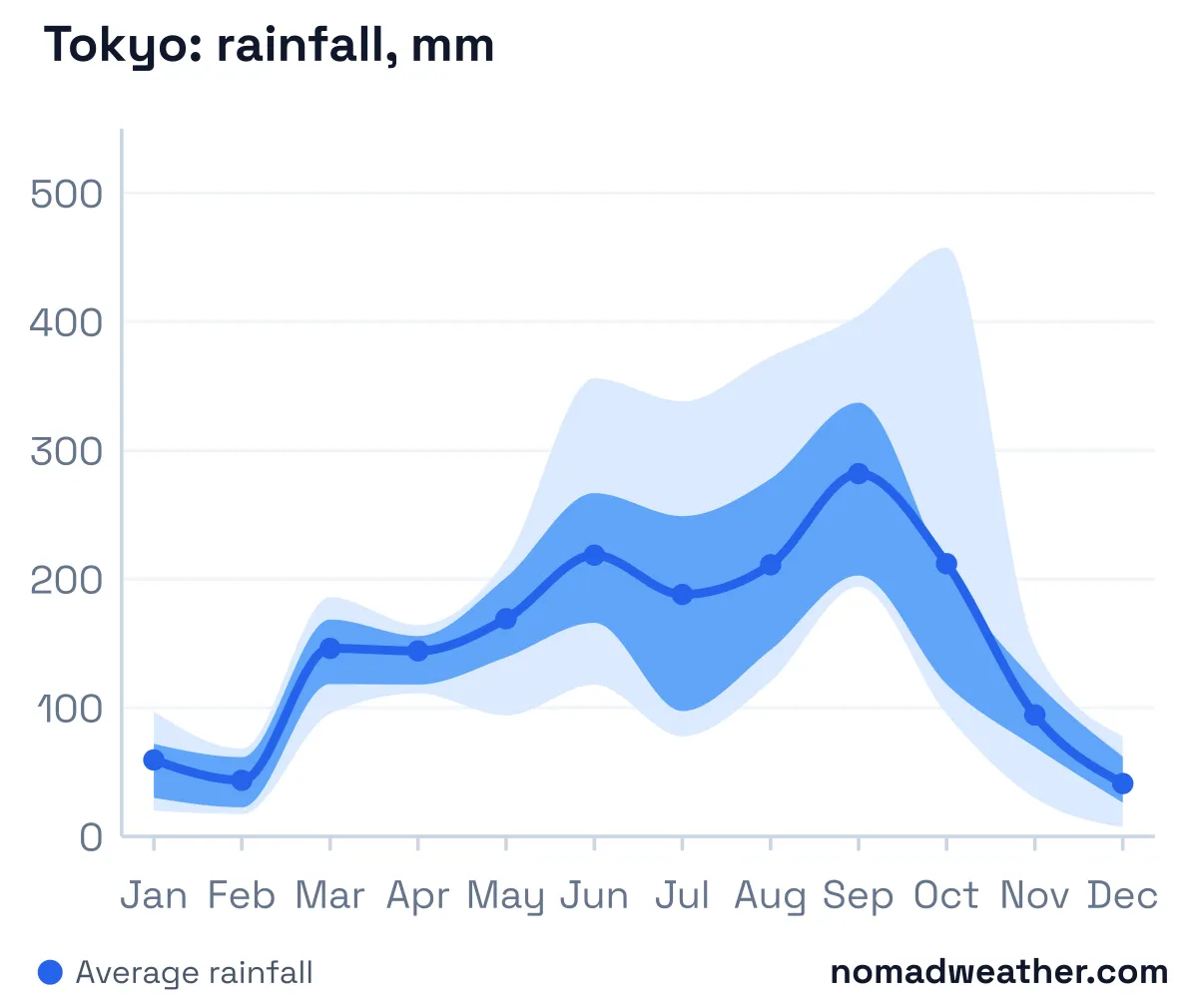
Averages 2015-2025 · Source: Open-Meteo, CHIRPS · How we measure
Read the line first: rain is lowest from December to February, steps up in March and stays high through October, with a peak in September. The band swings from nights at freezing in January to a high of 32°C in August. For one month at a time, the Tokyo destination page is quicker. A rain day here is a day with at least two millimetres, which is what rain gauges count outside the tropics.
Where to be next: your month-by-month route, $19
A route for your months with a leave-by date for each stop, a backup, and the seasonal traps on your path. Drafted from 11 years of weather data, every number checked against it, in your inbox within 48 hours. Not included: visas, insurance or bookings.
Is November the best month for a one-month stay?
Yes, if you mean mild, not warm. November has a high of 17°C, a low of 8°C, 94 mm of rain on about 8 of 30 days and humidity of 75 percent. It is the first month after the autumn wet period, with less than half the rain of October and about a third of September's, and less than any month from March to October.
It is not warm: you need a jacket in the evening, and by the end of the month it feels like early winter. If that is fine, it is the easiest month for a long stay, because you can walk, work from cafes and take day trips without planning around rain or heat. Late October has the same shape but is still wet.
What about spring, the other "clear window"?
Spring is pleasant, but it is not dry. March (14°C high, 5°C low), April (19°C and 10°C) and May (23°C and 15°C) each get about 10 rain days and 144 to 169 mm. That is about two more rain days than November in each month, with cloud climbing from 59 percent in March to 69 percent in May.
Most "best time to visit" pages treat late March to May as a clear window because the temperatures are good, and for a short trip that is fair. For a month, expect a rain day every three days or so. April and early May are the comfortable ones, with highs of 19°C to 23°C and a few fewer rain days than June.
What is the rainy season like?
June to mid-July is tsuyu, and June fits it in our numbers: 219 mm on about 13 of 30 days, with cloud of about 77 percent, the most of any month. Highs are 26°C and lows 19°C, so it is warm and damp rather than cold. July has 188 mm and about 13 rain days.
The days are grey more than they are stormy. If you work indoors it is a workable month in a city with plenty of covered places, but you will not get much of the sunshine people expect from a Japan trip.
How hot and humid is Tokyo in July and August?
July has a high of 30°C and a low of 23°C; August a high of 32°C and a low of 24°C, the hottest month of the year. Humidity is 80 percent in July and 78 percent in August, so the heat is the sticky kind, with nights that do not cool down much. August gets a little more rain than July (211 mm against 188 mm) but on fewer days (about 11 against 13). The heat, more than the rain, is what makes walking around hard.
When are the typhoons?
Late summer into early autumn. September is the wettest month in our data, and October is still wet at 212 mm on about 11 days. These are monthly totals, so one or two big storms can account for much of them; our data does not tell typhoons apart from other rain, and we do not claim a typhoon count. Treat September and October as wet months in which a day or two can be lost to storms, and check the Japan Meteorological Agency forecast in the week before you travel.
Is winter a good time to stay?
It is the sunniest and driest part of the year, and also the coldest. January has a high of 9°C and a low of 0°C, about 4 rain days and the lowest cloud of the year, about 40 percent. February is 10°C and 1°C with about 5 rain days, and December is 12°C and 3°C with about 5.
The days are bright and clear, which many people find better than the grey of June. But the nights are at or near freezing, and the wind chill matters more than the numbers suggest. If you are comfortable with winter, January and February are the easiest months for work, with little rain to plan around. If you want warmth, go somewhere else: our November guide and December guide list warm places.
Which month for which kind of stay?
- One month, easiest weather: November.
- One month, a bit warmer, accepting showers: April or early May.
- Bright and cold: December to February.
- Grey and humid, fine if you work indoors: June.
- Avoid for a first long stay: September, then July and August for the heat.
For a comparison of what a mild November looks like elsewhere, Tokyo sits between Lisbon, which is warmer and wetter, and Tbilisi, which is colder and drier:
November averages, side by side
| Place | High | Low | Rain | Rain days |
|---|---|---|---|---|
| Tokyo | 17° | 8° | 94 mm | 8 |
| Lisbon | 18° | 12° | 119 mm | 8 |
| Tbilisi | 12° | 3° | 35 mm | 5 |
Averages 2015-2025 · Source: Open-Meteo, CHIRPS · How we measure
This is a weather view only. It does not cover flights, visas, rent or crowds, so check those before booking. More on those two: Tbilisi and Lisbon.
How sure are these numbers?
They are month-of-year averages for a single point in central Tokyo, from stored climate data (Open-Meteo archive and CHIRPS rain totals, 2015 to 2025), so any single year can be wetter, hotter or clearer. Cloud is the average share of sky covered through the day, not hours of sunshine. Rain days are the stored share of days with at least two millimetres, times the days in the month, rounded to the nearest day.
Frequently asked questions
What is the best month to stay in Tokyo for a month?
November in our data. The high is 17°C, the low 8°C, 94 mm of rain falls on about 8 of 30 days, and cloud is down to about 51 percent. Late March to May is as mild but gets about 10 rain days a month and 144 mm or more.
When is the rainy season in Tokyo?
June to mid-July is the formal rainy season (tsuyu). In our data June has 219 mm on about 13 of 30 days with the cloudiest sky of the year, about 77 percent.
Is Tokyo too hot and humid in summer?
July and August are hot: highs of 30°C and 32°C, lows of 23°C and 24°C, and humidity of 80 and 78 percent. It is the weather that makes people choose air-conditioned cafes over walking.
When are typhoons in Tokyo?
Late summer to early autumn. September is the wettest month in our data at 282 mm on about 13 of 30 days, and October still gets 212 mm. Our data does not separate typhoons from other rain, so it shows the total, not individual storms.
Is Tokyo cold in winter?
Cold but bright. January has a high of 9°C and a low of 0°C, only about 4 rain days and the lowest cloud of the year, about 40 percent.
Not sure where yet? Pick your months and what to avoid, and get your 3 best places → Where should I go?
Weather data: Open-Meteo (CC BY 4.0), open-meteo.com; rain totals: CHIRPS (Climate Hazards Center, UC Santa Barbara). Processed by NomadWeather from stored copies of the data.