
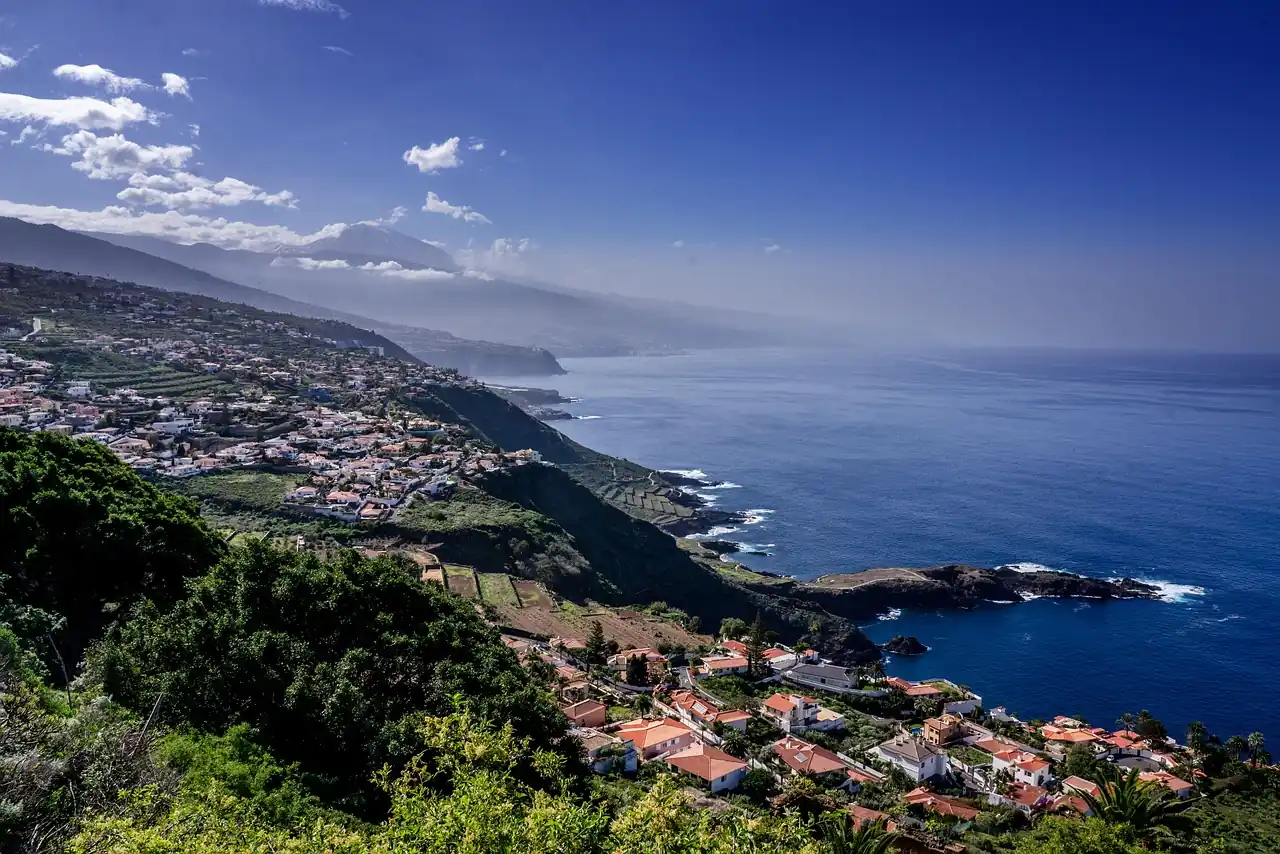
What is the weather like in the Canary Islands through the year?
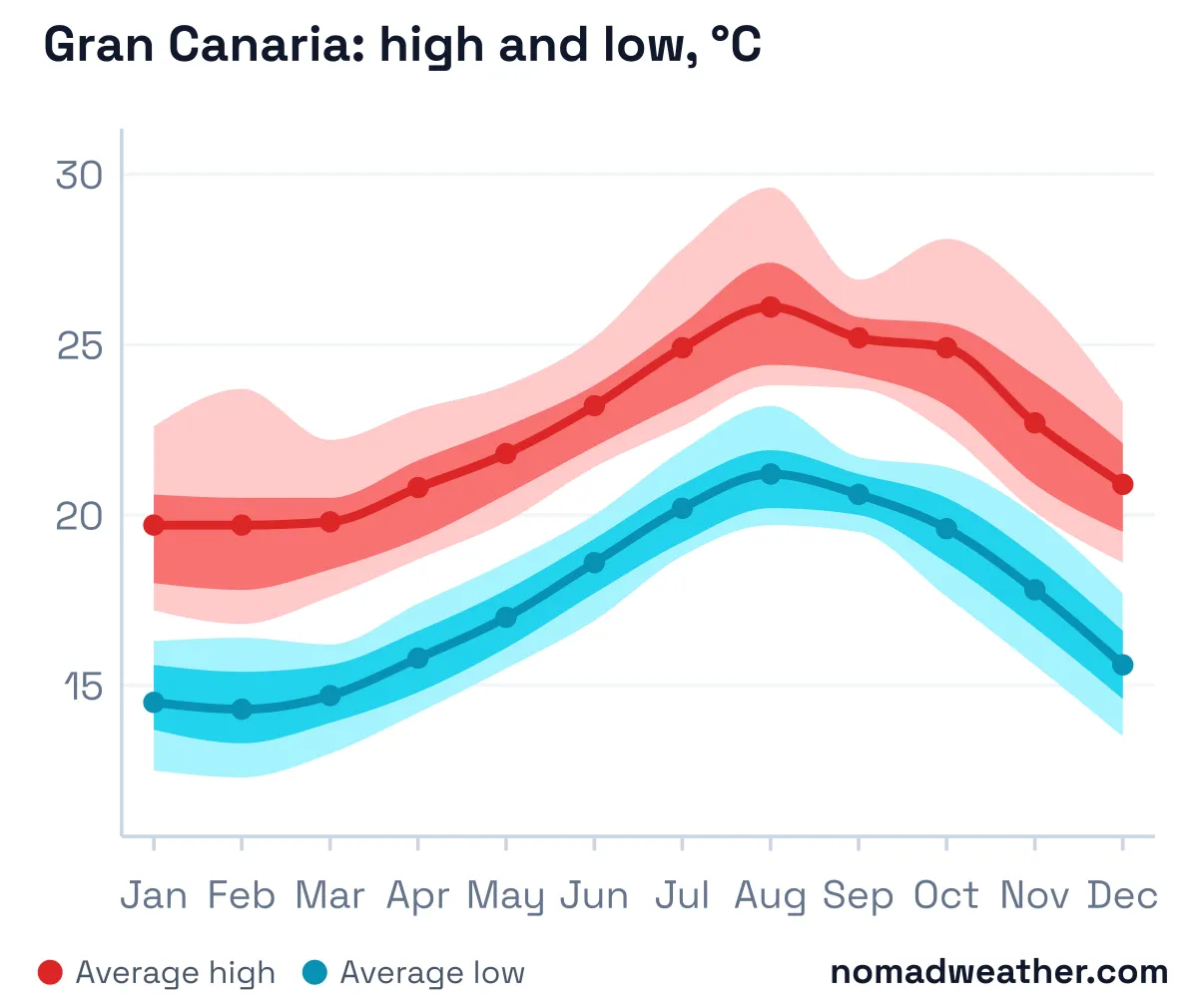
Mild all year, with the smallest swing between winter and summer of any place we track in Europe. Our one Canary Islands point is Las Palmas on Gran Canaria. There the average daytime high is 20° in January and February and 26° in August. Nights run from 14° in February to 21° in August. In Lisbon the same swing is far wider, which is why the islands are the usual European winter base: the cold months are mild, and the hot months are not extreme.
Gran Canaria: Average high and low temperature, °C
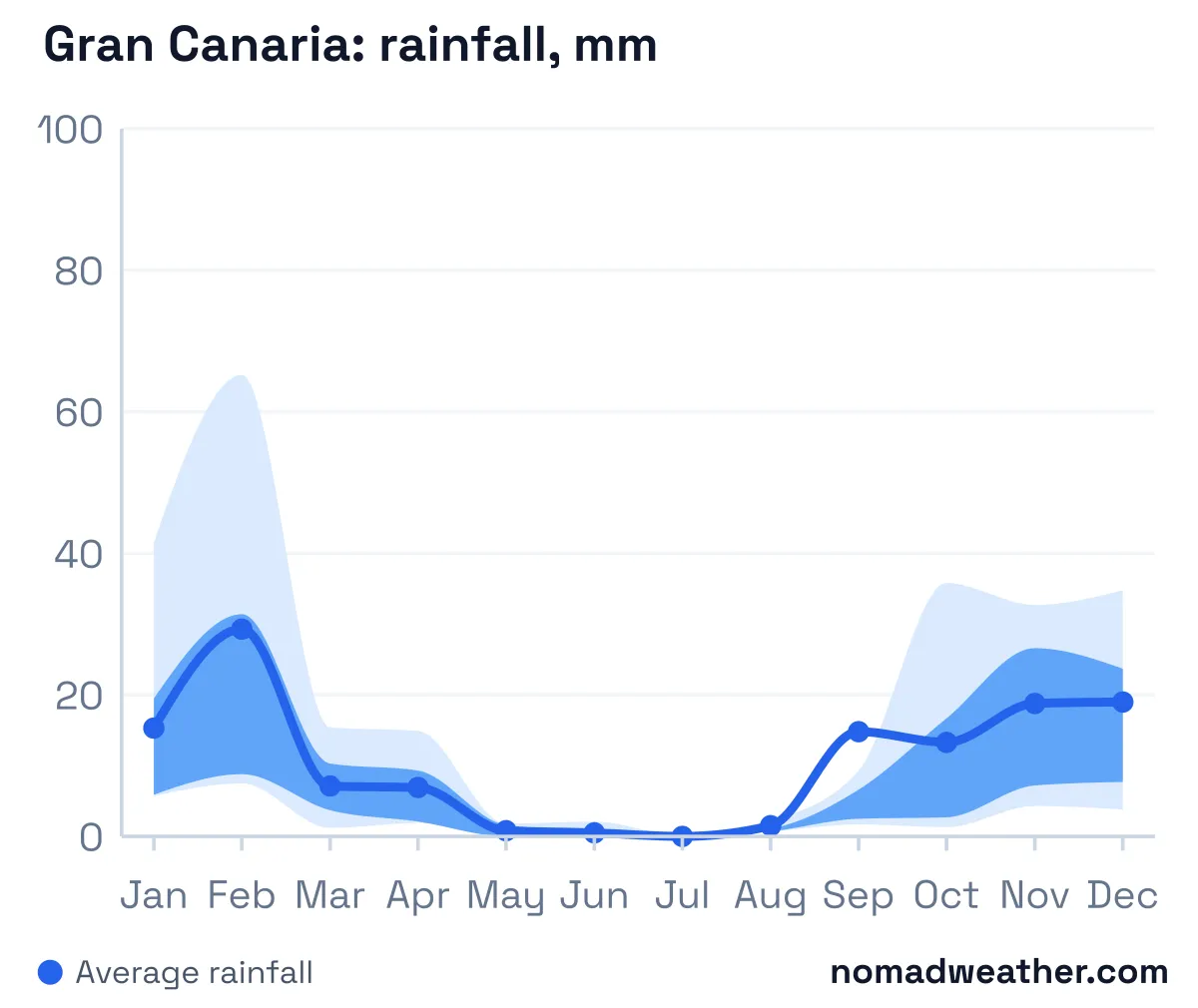
Gran Canaria: Rainfall, mm
Averages 2015-2025 · Source: Open-Meteo, CHIRPS · How we measure
Read the chart in two halves. The temperature band is nearly flat from December to April and climbs gently to a peak in August. The rain line sits close to zero for half the year. It is not an "eternal spring": winter nights of 14° to 16° and rain on about a day in five say otherwise.
One note on the chart: Las Palmas is a coastal city on the north-east of the island, and the airport station nearby reads about a degree warmer. Other travel sites quote hotter summers for the archipelago, mostly because they use a southern or inland station. We hold one point, so read our temperatures as the cool end of what you will find on the islands.
Where to be next: your month-by-month route, $19
A route for your months with a leave-by date for each stop, a backup, and the seasonal traps on your path. Drafted from 11 years of weather data, every number checked against it, in your inbox within 48 hours. Not included: visas, insurance or bookings.
Which months bring the rain in the Canary Islands?
Mostly November to February by volume, and October to March by number of days. In millimetres February is our wettest month at 29 mm, then December and November at 19 mm each. January has 15 mm and March only 7. From May to August the stored totals are close to zero.
Rain days are the part that matters if you work from a terrace. Rain falls on about 6 days in January, 6 in February, 7 in March, 7 in October and 7 in November, but only about 1 day in July and August. So winter here means short, light showers on one day in four or five, not long wet spells. A rainy day is a day with at least 2 mm, which is what rain gauges count.
Which months are warm enough for the beach?
July to October, on air temperature. The high is 25° in July, 26° in August and 25° in September and October, with lows of 20° to 21°. That is warm without being hot, with almost no rain from June to August. In May and June the high is 22° and 23°: pleasant, but you may still want a layer in the evening.
We hold no sea temperature. The sources we read agree that the Atlantic here is coolest in winter and warmest around September. If swimming is the point of your stay, plan for September or October, not January.

What about the wind?
Our stored average wind speed is highest from June to August and lowest in October. That matches the trade winds, which blow most of the year and are strongest in summer, especially on the eastern islands and exposed beaches. We have one wind figure per month for one point, so we say nothing about gusts, kite spots or a particular beach. What it does tell you is that a July terrace is breezier than an October one, and that a 26° August day feels cooler in the wind than the number suggests.
What is the best time to visit the Canary Islands?
It depends on what you are comparing with. Our reading, on weather alone:
- Warm with few rainy days: April to June and September. The high runs from 21° in April to 23° in June, and is 25° in September. Our weather model counts rain on 3 to 5 days a month, but the rain totals for May and June are close to zero (1 mm each), so expect the odd light shower at most. Nights are 16° in April and 17° or more from May.
- Driest and hottest: July and August. Rain on about 1 day a month, highs of 25° and 26°, and the strongest wind of the year.
- Warm but more often wet: October and November. The high is 25° in October and 23° in November, but rain falls on about 7 days in each, as many as in any month.
- Mild and showery: December to March. A 20° to 21° high, nights of 14° to 16°, and rain on 5 to 7 days a month. It is the choice if the alternative is a cold, dark northern winter, not if you want swimming weather.
For the winter month most people ask about, see Canary Islands weather in January.
Which island?
Gran Canaria (Las Palmas)
20° high in Jan15° low in Jan15 mm in Jan
The one island we measure: a real city with coworking, fast internet and a city beach. Chips show January.
Suits: a mild, even climate and a city base
South Gran Canaria and south Tenerife
Sources report sunnier and a degree or two warmer than the north. Not in our data; most winter-sun stays are based here.
Suits: the best chance of sun on the sand
North Tenerife and La Palma
Sources report greener, with more cloud and some winter rain. Not in our data.
Suits: hiking more than a sunny terrace
Lanzarote and Fuerteventura
Sources report flatter, drier and windier, with the beaches. Not in our data.
Suits: beaches and steady wind; weigh down your papers
How do the Canaries compare with Madeira and Lisbon?
Warmer than both in winter, and much drier than Madeira. In January Madeira is cooler by day than Gran Canaria and wetter, and our Madeira or Canary Islands in winter page has the months side by side. In summer the order changes: Madeira also has a dry July and August and is a degree warmer by day than the Canaries, while the Canaries stay drier still. Lisbon is the hottest of the three in July.
January and July averages, side by side
| Place | High | Low | Rain | Rain days |
|---|---|---|---|---|
| Gran Canaria Jan | 20° | 15° | 15 mm | 6 |
| Gran Canaria Jul | 25° | 20° | 0 mm | 1 |
| Madeira Jan | 19° | 14° | 73 mm | 6 |
| Madeira Jul | 26° | 20° | 13 mm | 2 |
| Lisbon Jan | 15° | 9° | 91 mm | 7 |
| Lisbon Jul | 28° | 18° | 1 mm | 0 |
Averages 2015-2025 · Source: Open-Meteo, CHIRPS · How we measure
Which Canary Island should you pick?
The Canary Islands are seven main islands with very different climates, and we hold a single point for all of them. Everything on this page describes Las Palmas on Gran Canaria, so use it for the shape of the year and check the island you are looking at before you book. The cards give what the sources we read say about the others, which we have not checked against our own data.
What would we do?
For a month of work in mild weather: April to June or September, when it is warm with few rainy days. For the cold-weather escape from northern Europe: December to March, accepting a light jacket in the evening and a shower now and then. For beach weather in the water, September and October. And if you need 28° or more, the Canaries are not the answer in any month.
How we got these numbers
Eleven years of weather, averaged by month, stored on NomadWeather: temperatures, cloud, wind and rainy days from Open-Meteo (CC BY 4.0), monthly rain totals from CHIRPS (satellite and rain-gauge data), except for Madeira, where we use the Open-Meteo weather model because the satellite source reads several times too wet on a steep island. Rainy days are the stored share of days with at least 2 mm of rain times the days in the month, rounded to a whole day. A given year can be warmer, cooler or wetter than the average, and we do not forecast one. For the station normal of Las Palmas, see the Las Palmas article on Wikipedia.
Frequently asked questions
What is the best month to visit the Canary Islands?
On our Gran Canaria numbers, April to June and September give the best mix of warmth and few rainy days (3 to 5 a month); July and August are the choice for dry, hot days. October and November are warm too but have rain on about 7 days each, and winter is mild at a 20° to 21° high with rain on 5 to 7 days a month.
What is the rainiest month in the Canary Islands?
February has the most rain in our data (29 mm), followed by December (19 mm) and November (19 mm). By number of days, October, November and March are the rainiest, with rain on about 7 days each.
How much does the temperature change through the year?
Little. The average high moves from 20° in January to 26° in August, about 6 degrees, and the average low from 14° to 21°.
Is it windy in the Canary Islands in summer?
Our stored wind figure is highest from June to August and lowest in October. That fits the trade winds, which are strongest in summer, but we hold one point and one average, so we give no gust or beach-by-beach claims.
When is the sea warmest in the Canary Islands?
The sources we read put the warmest water in September and the coolest in winter, but we hold no sea temperature of our own, so we give no figure.
Do all the Canary Islands have the same weather?
No, but we cannot show it: our data has one Canary Islands point, Las Palmas on Gran Canaria. Treat these numbers as the middle of the range, not as Tenerife, Lanzarote or La Palma.
Not sure where yet? Pick your months and what to avoid, and get your 3 best places → Where should I go?
Weather data: Open-Meteo (CC BY 4.0), open-meteo.com; rain totals: CHIRPS (Climate Hazards Center, UC Santa Barbara); Funchal (Madeira): Open-Meteo. Processed by NomadWeather from stored copies of the data.