
What is the weather in Florianópolis, in one minute?
Florianópolis (often typed Florianopolis) has a warm, wet summer and a cool, damp winter, and no truly dry season. Most travel sites say October to April is the best time to go, which is true for the beach. For a month of work, April and November are the easiest, and January is the wettest month of the year. Here is the whole year:
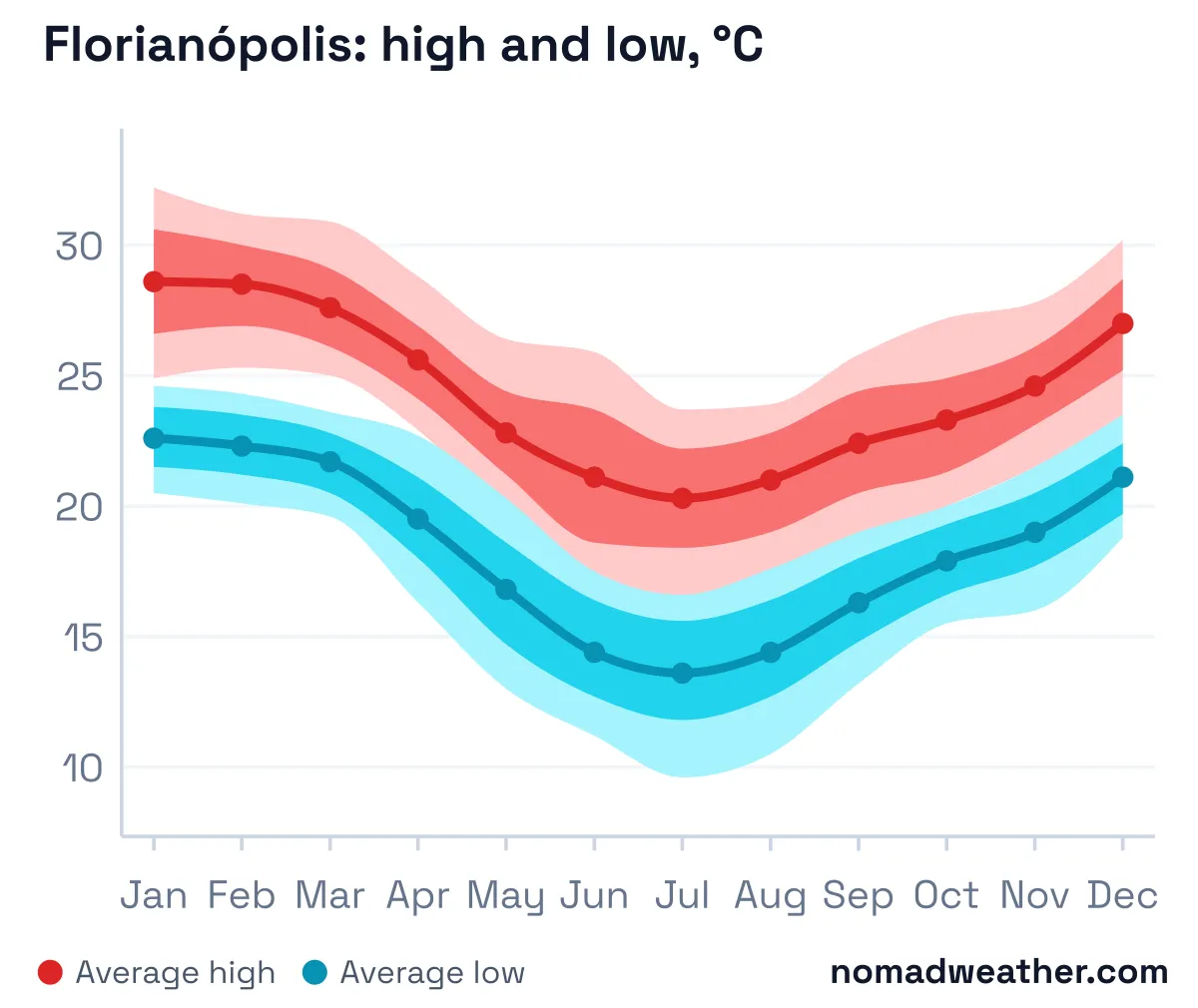
Florianópolis: Average high and low temperature, °C
Florianópolis: Rainfall, mm
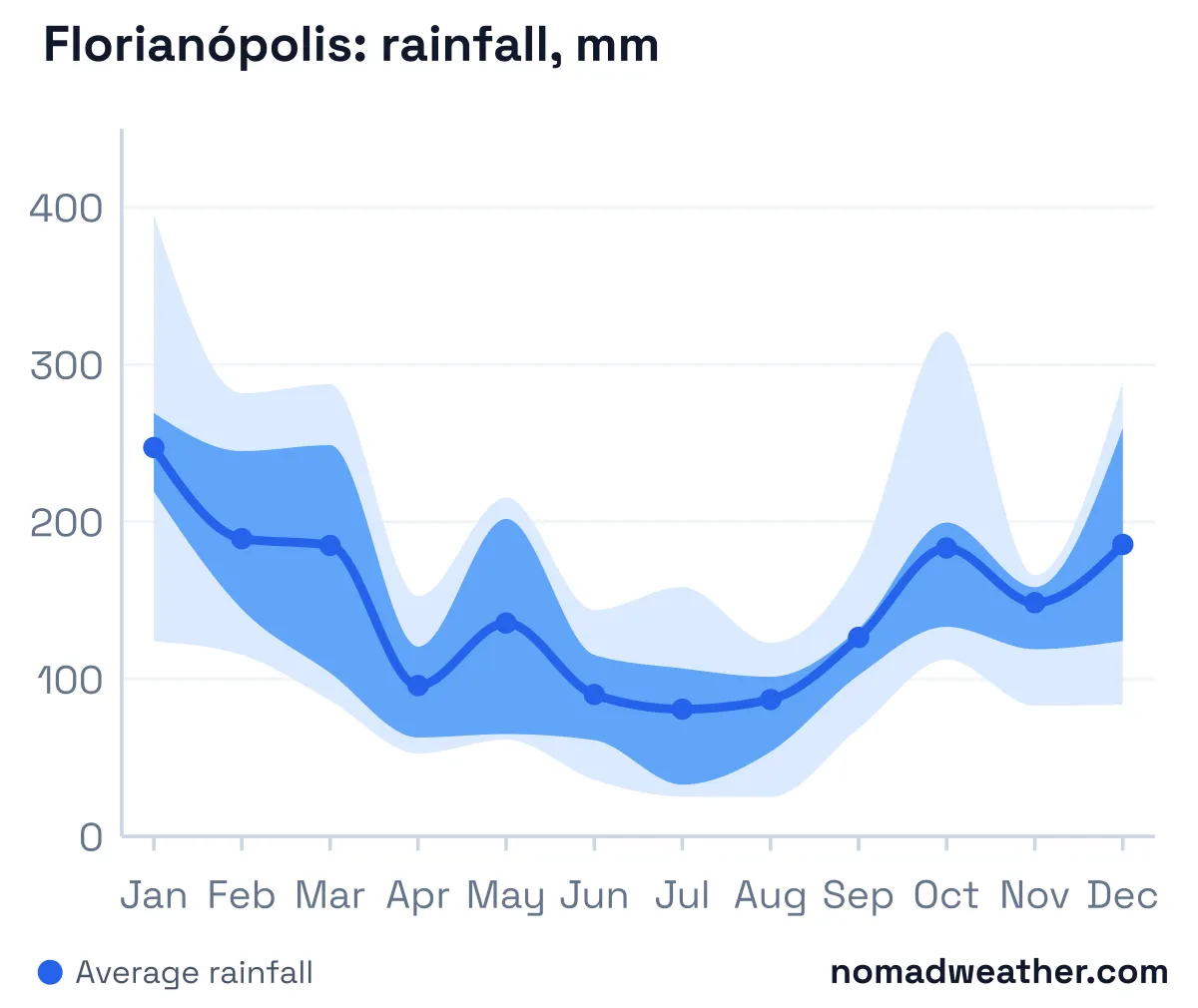
Averages 2015-2025 · Source: Open-Meteo, CHIRPS · How we measure
Read the rain line first: it peaks in January, stays high through March, drops in April, and bottoms out in July before climbing again from September. Temperatures follow, from 29° highs in summer to 20° in July. For one month at a glance, use the Florianópolis destination page.
Where to be next: your month-by-month route, $19
A route for your months with a leave-by date for each stop, a backup, and the seasonal traps on your path. Drafted from 11 years of weather data, every number checked against it, in your inbox within 48 hours. Not included: visas, insurance or bookings.
Is Florianópolis too wet in January?
It is the wettest month in our data: 247 mm of rain, on about 16 of 31 days, with a high of 29°C and a low of 23°C. Humidity is about 80 percent and cloud cover about 70 percent, so it is warm and heavy more than sunny. February (189 mm), March (185 mm) and December (186 mm) are lighter but still wet. Treat December to March as one warm, showery block: good for the sea, harder for a plan built around dry days outdoors.
Rio, about 750 km up the coast, has the same shape but is drier in summer; see Rio weather by month. For warm places with less rain, see where is warm in January and February.
What is the winter like?
June to August is the cool season: highs of 20°C to 21°C, lows of 14°C and 81 to 90 mm of rain a month, July the driest. It is mild by day and cool at night. Humidity is about 83 percent, so winter feels damp. It is a good time to work from a café and a poor one for the beach.
What about April, May, September, October and November?
These are the shoulder months, and April is the best of them: a high of 26°C, a low of 20°C and 96 mm of rain, the driest month outside winter. May falls to 23°C by day with 136 mm. September (127 mm) and October (183 mm) are cool and cloudy, October the cloudiest month at 78 percent. November warms to a high of 25°C with 149 mm.
For a long stay, April and November are the two easiest months if you want some warmth without the full summer rain.
What about the wind?
The island is known for wind and for kite and surf. Our monthly average is a flat line, about 3 m/s all year, and it hides the strong sea-breeze days kiters look for, so it cannot name the best kite month. Check a local forecast.
How does it compare with Rio?
Florianópolis is cooler in winter and wetter than Rio in eleven months of the year, April being the exception.
January and July averages, side by side
| Place | High | Low | Rain | Rain days |
|---|---|---|---|---|
| Florianópolis Jan | 29° | 23° | 247 mm | 16 |
| Florianópolis Jul | 20° | 14° | 81 mm | 6 |
| Rio de Janeiro Jan | 31° | 24° | 152 mm | 9 |
| Rio de Janeiro Jul | 25° | 18° | 42 mm | 3 |
Averages 2015-2025 · Source: Open-Meteo, CHIRPS · How we measure
Read across the two months: Florianópolis is cooler than Rio in both, and wetter in both, with 247 mm against 152 mm in January and 81 mm against 42 mm in July.
Who should come when?
For a month of work, April and November are the easiest: warm enough, with less rain than summer. May and September are cooler, and October is nearly as wet as March (183 mm against 185 mm). For beach weather, January to March is warm, but you pay for it in rain and humidity. For a quiet, cool stay, June to August works if you do not need the sea.
What would we do?
Arrive in November as it warms, stay through the summer if you can accept showers, and leave by April. If you can only pick one month for work, pick April.
This is a weather view only. It does not cover prices, safety, internet or the cost of living.
How sure are these numbers?
They are month-of-year averages for a single point near the city, from stored climate data (Open-Meteo archive and CHIRPS rain totals, 2015 to 2025), so any single year can be much wetter or drier. We hold one point for Florianópolis, so we cannot say how the north of the island, the south or the mainland differ; check a forecast for the beach you pick. Rain days are the stored share of days with at least two millimetres, times the days in the month, rounded to the nearest day. Other sources use different periods and give different totals, so compare the shape of the year, not the last millimetre.
Frequently asked questions
What is the best time to visit Florianópolis?
For beach weather, December to March, with highs of 27°C to 29°C, though it is also the wettest stretch. For a long stay with milder heat and less rain, April and November are the compromise.
What is the weather in Florianópolis in January?
Hot, humid and wet: a high of 29°C, a low of 23°C and 247 mm of rain, the most of any month in our data.
Is Florianópolis cold in winter?
Cool rather than cold. June to August highs are 20°C to 21°C and lows 14°C, with humidity near 83 percent, so rooms feel damp. It is not beach weather.
When is the driest time in Florianópolis?
July is the driest month in our data at 81 mm, with June at 90 mm and August at 87 mm. Nowhere in the year is truly dry.
Is Florianópolis good for working in December?
It is warm (a high of 27°C, a low of 21°C) with 186 mm of rain. It works if you accept humid, showery weather.
Not sure where yet? Pick your months and what to avoid, and get your 3 best places → Where should I go?
Weather data: Open-Meteo (CC BY 4.0), open-meteo.com; rain totals: CHIRPS (Climate Hazards Center, UC Santa Barbara). Processed by NomadWeather from stored copies of the data.