

What is Lima's year like?
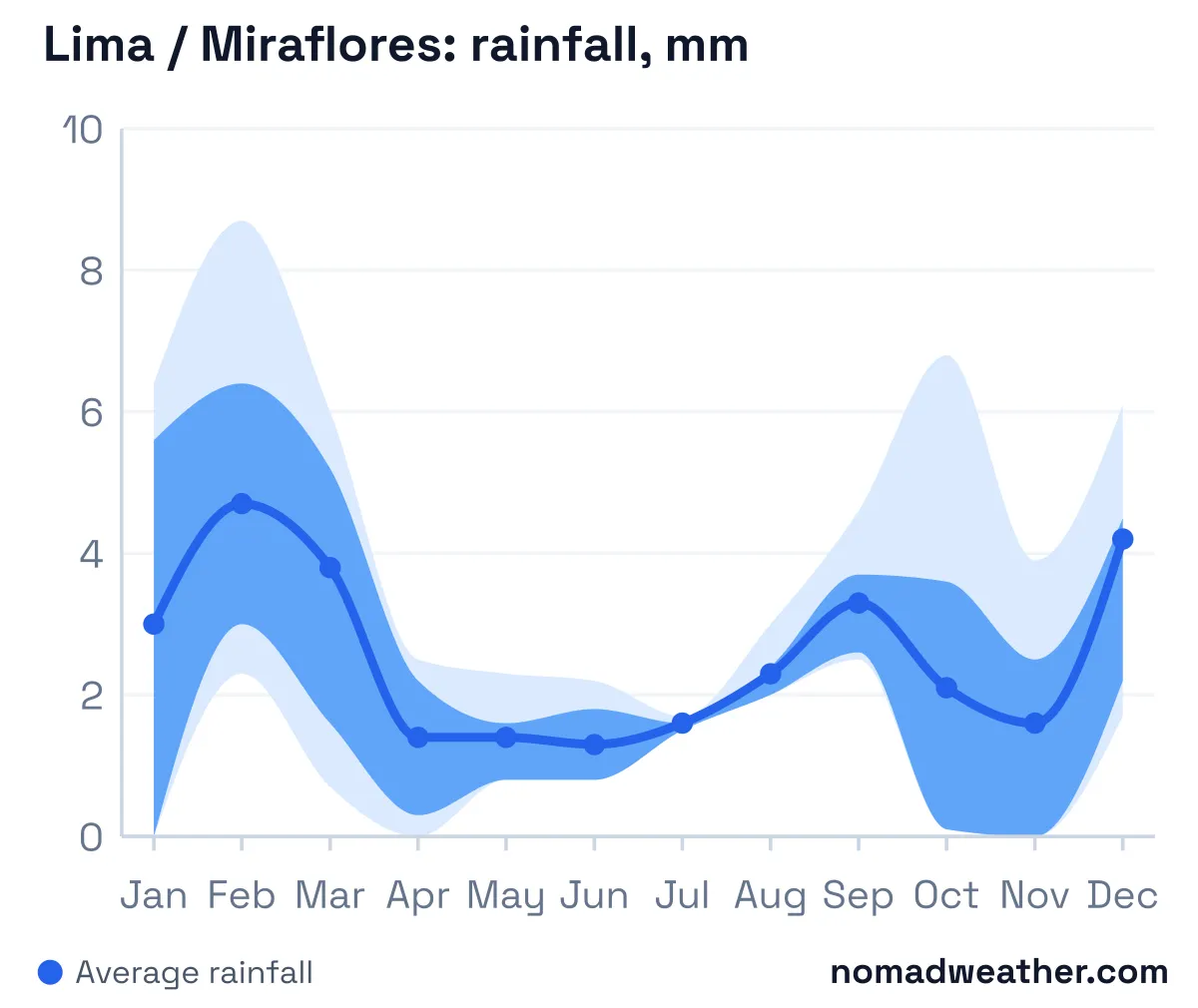
Lima has almost no rain and still has seasons, so "when is the rainy season" is the wrong question. The right one is warm or cool. In our data no month has more than 5 mm of rain or more than 2 rainy days. Here is the year, with the high and low temperature and the rain:
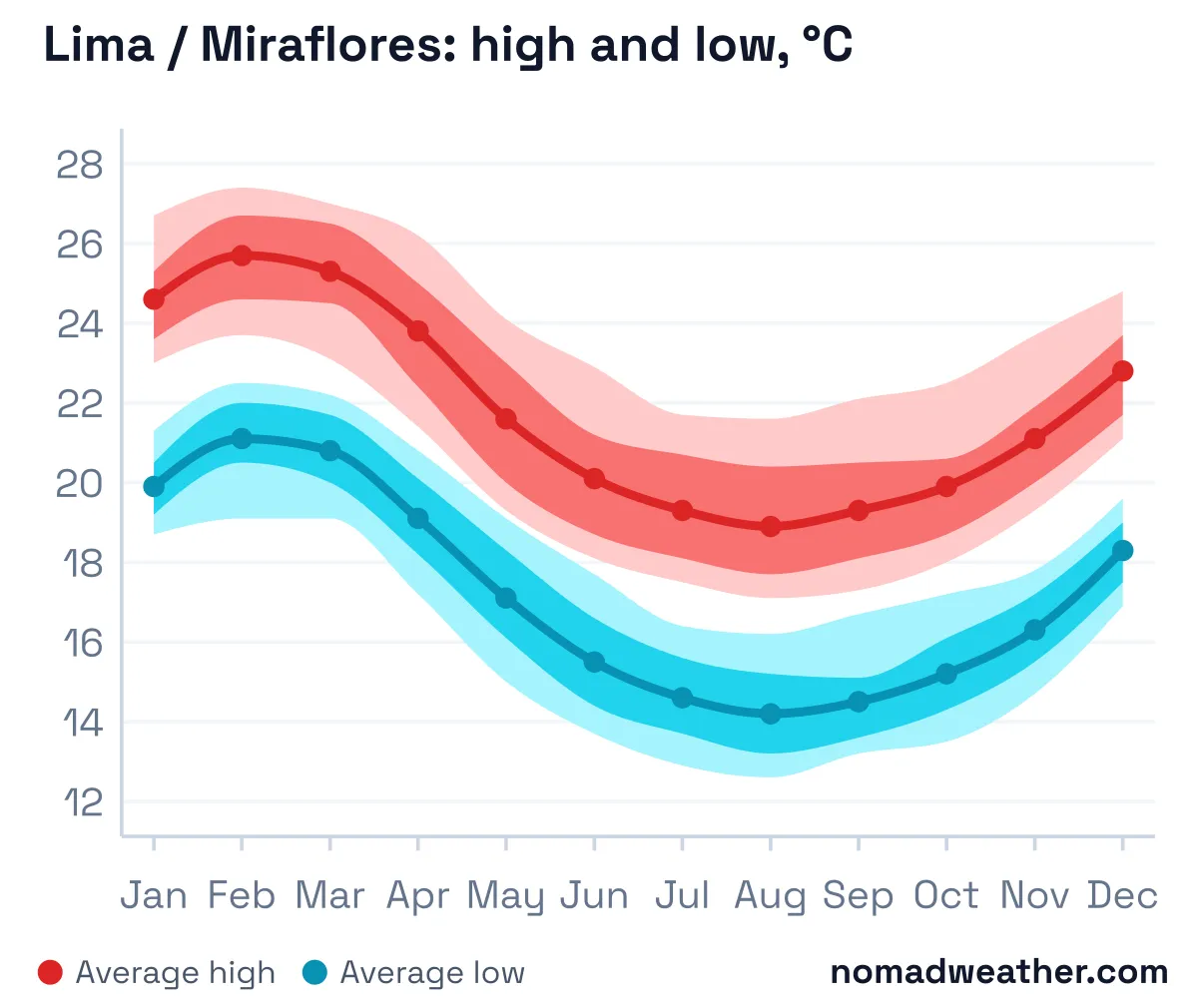
Lima / Miraflores: Average high and low temperature, °C
Lima / Miraflores: Rainfall, mm
Averages 2015-2025 · Source: Open-Meteo, CHIRPS · How we measure
Read the temperature chart, not the rain one. Summer runs from December to April and the cool half from June to October. May and November are the shoulders, mild days with nights of 16°C to 17°C.
Where to be next: your month-by-month route, $19
A route for your months with a leave-by date for each stop, a backup, and the seasonal traps on your path. Drafted from 11 years of weather data, every number checked against it, in your inbox within 48 hours. Not included: visas, insurance or bookings.
When is Lima warmest?
February, with a 26°C high and a 21°C low. January and March are almost the same, December is the first summer month and April the last. In those months the nights stay close to the day, so you rarely need more than a light layer, and many people manage a coastal flat with the window open.
It is not hot by tropical standards: even February is a good day, not a heat wave. If you want real heat and a swim, look at Rio or the Caribbean instead.
Is Lima grey and cool in winter?
Cool, yes, and grey. A low layer of sea cloud sits over the city for much of the winter. Lima airport records about 185 hours of sunshine in January but only 30 to 60 hours a month from June to October, so do not count on a sunny winter. (Our own cloud figure counts high cloud too and does not show this difference, so here we go by the airport's records.) August is the coolest month, with a 19°C high and a 14°C night.

The lack of rain makes planning easy, since a rooftop desk or a walk on the cliffs never depends on the forecast. What changes is the flat: homes are rarely heated, and a 14°C night inside a concrete building is chilly. Ask about a heater or an extra blanket before you book a winter stay.
How does Lima compare with Bogotá and Rio?
The table puts February side by side for two other South American bases.
February averages, side by side
| Place | High | Low | Rain | Rain days |
|---|---|---|---|---|
| Lima | 26° | 21° | 5 mm | 2 |
| Bogotá | 20° | 9° | 75 mm | 7 |
| Rio | 30° | 24° | 144 mm | 9 |
Averages 2015-2025 · Source: Open-Meteo, CHIRPS · How we measure
Against Bogotá, Lima is warmer by day and much warmer at night, and a lot drier. Against Rio, it is cooler and drier. For the other southern-hemisphere cities that peak in the same months, see southern-summer city bases. For any one month of Lima, the Lima page is faster.
What do the shoulder months give up?
Very little. May and November give up a few degrees against summer and keep the same dry skies. The gap between a May night and a February night is only about four or five degrees, so packing barely changes between the two. October is the first month that feels like spring, but the cloud is still low over the city, so judge it by the grey and not by the temperature. If you stay for a month or more, choose the cool half only if you do not mind working under a flat white sky and wearing a layer indoors.
What should a remote worker do?
Our take, on weather alone:
- Want a warm, dry base for the northern winter: December to April, with January to March the warmest.
- Want to avoid grey, cool days: skip June to September, when the sun rarely comes through.
- Want neither extreme: May, October and November are mild and just as dry.
- Want a hot beach month: see where is warm in January.
A note on the numbers
Eleven years of weather, averaged by month, stored on NomadWeather: temperatures and cloud from Open-Meteo (CC BY 4.0), monthly rain totals from CHIRPS (satellite and rain-gauge data). The data point is central Lima, a few kilometres from the sea; Miraflores on the cliffs is close by. Sunshine hours are from Lima's Jorge Chávez airport station (1991 to 2020 averages). A rainy day is a day with at least four millimetres of rain, the bar we use in the tropics. A particular year can be warmer or cooler than the average, and we do not forecast a given year.
Frequently asked questions
What is the best time to visit Lima for weather?
January to April. Highs are 24°C to 26°C, nights 19°C to 21°C, and rain is close to zero. February is the warmest month at a 26°C high and a 21°C low.
Does it rain in Lima?
Hardly. The wettest month in our data is February with 5 mm, and rain falls on about 0 to 2 days in any month. Lima is one of the driest large cities we track.
Is Lima cold in winter?
Cool, not cold. From June to October the average high is 19°C to 20°C and the low 14°C to 15°C. August is the coolest month. You want a jacket and a layer indoors, as few buildings are heated.
Is Lima good for a beach stay in January?
It is the warmest stretch, with a 25°C high and a 20°C night. We do not hold sea temperature, so we cannot tell you how cold the Pacific is; coastal districts like Miraflores are better for walks and views than long swims.
Is Lima warmer than Bogotá?
Yes, in every month. In January Lima has a 25°C high and a 20°C low; Bogotá has a 20°C high and an 8°C low.
Not sure where yet? Pick your months and what to avoid, and get your 3 best places → Where should I go?
Weather data: Open-Meteo (CC BY 4.0), open-meteo.com; rain totals: CHIRPS (Climate Hazards Center, UC Santa Barbara). Processed by NomadWeather from stored copies of the data.