
What is Paje's year like?
Paje, on the east coast of Zanzibar, has not one dry season but two, with long rains between them. June to October is the main dry season. A shorter, hotter dry spell comes in January and February. The long rains fall from March to May, and a lighter wet patch comes in November and December.
Paje (Zanzibar): Average high and low temperature, °C
Paje (Zanzibar): Rainfall, mm
Averages 2015-2025 · Source: Open-Meteo · How we measure
A rain day here is a day with at least four millimetres of rain, the bar we use in the tropics, so a brief shower does not count.
Where to be next: your month-by-month route, $19
A route for your months with a leave-by date for each stop, a backup, and the seasonal traps on your path. Drafted from 11 years of weather data, every number checked against it, in your inbox within 48 hours. Not included: visas, insurance or bookings.
What are the two dry seasons?
June to October is the one most guides name. Rain falls on 4 days in June, 2 in July, 1 in August, 1 in September and 4 in October, and the total falls from 77 mm in June to about 32 mm in August and September, then rises to 83 mm in October. August and September are the driest and clearest. Highs are the lowest of the year, 27°C to 29°C, nights are 23°C to 24°C and the wind is steady. This is the best stretch for a long stay if you do not like the heat.
January and February is the shorter dry spell, and it is different weather. It is hot, with highs of 30°C and nights of 26°C, the warmest of the year. Rain falls on 7 days in January (92 mm) and 4 in February (53 mm). It is humid and cloudy, so it feels close, and a fan or air conditioning matters in a rental: ask about it before you book. February is the better of the two months.
How bad are the long rains, March to May?
Bad, and April is the worst month by some way. March (153 mm, 11 rain days) is the first heavy month, still hot at 30°C. April has 438 mm and rain on about 21 of 30 days, with the heaviest cloud and the stickiest air of the year. May (225 mm, 13 rain days) is about half of April, and it is already easing as highs drop to 28°C.
Many hotels and restaurants on the coast close or cut hours in April and May, so a month of work in the rains is quieter and cheaper, but wetter. June is the way out: 77 mm and 4 rain days.
What about November and December, the short rains?
Less severe, and often just a short shower. November has 140 mm on 9 rain days and December 141 mm on 11, with highs of 29°C to 30°C. Allow a few wet days at Christmas, though it is nothing like April. The wind is also light in these months, which matters if you come for the kites.
How windy is Paje, and what does it mean for kitesurfing?
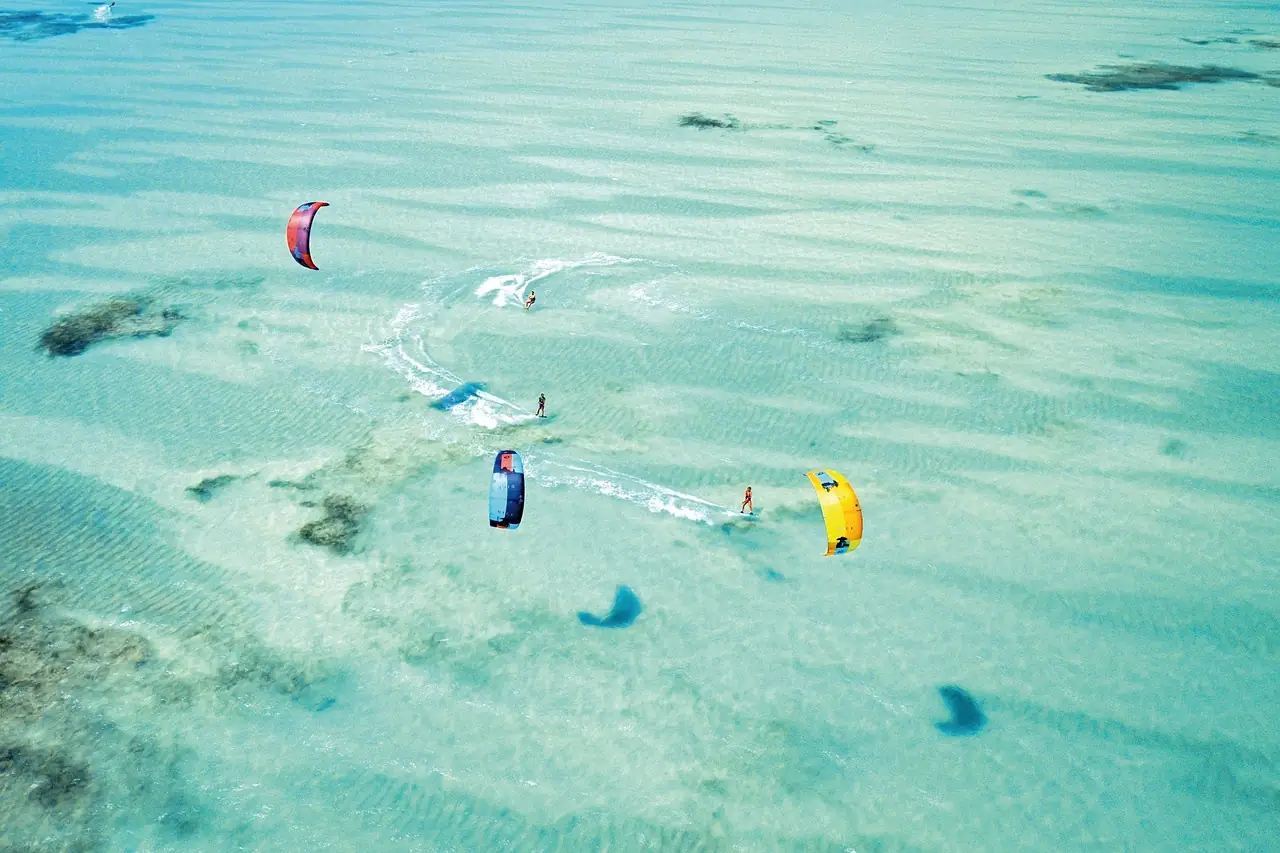
Paje is known for its kite lagoon. Local guides describe two wind seasons: the kusi from the south-east, roughly June to October, which is the stronger, and the kaskazi from the north-east, roughly mid-December to March, which is lighter (The Kitespot). Our own data is a daily average, not gusts. By that measure the windiest months are June and July, at 17 to 18 km/h, with May close behind, and the calmest are March, November and December, at 11 to 12 km/h. January and February sit between, at 14 to 15 km/h. A daily average hides the sea breeze that builds in the afternoon, so it understates riding conditions, and in the lagoon the tide matters as much as the wind. Use it for the pattern, not for a launch decision, and expect the calmer months to be less reliable for kiting.
How does Paje compare with Diani and Mauritius?
Two other warm places on the same ocean give the year a different shape. Here is January to March side by side:
January, February and March averages, side by side
| Place | High | Low | Rain | Rain days |
|---|---|---|---|---|
| Paje (Zanzibar) Jan | 30° | 26° | 92 mm | 7 |
| Paje (Zanzibar) Feb | 30° | 26° | 53 mm | 4 |
| Paje (Zanzibar) Mar | 30° | 26° | 153 mm | 11 |
| Diani Beach Jan | 31° | 25° | 21 mm | 2 |
| Diani Beach Feb | 31° | 26° | 9 mm | 1 |
| Diani Beach Mar | 31° | 26° | 74 mm | 6 |
| Mauritius Jan | 30° | 25° | 224 mm | 11 |
| Mauritius Feb | 30° | 25° | 164 mm | 8 |
| Mauritius Mar | 30° | 25° | 124 mm | 7 |
Averages 2015-2025 · Source: Open-Meteo, CHIRPS · How we measure
Diani Beach in Kenya is drier still in January and February, but shares the long rains, with its wettest months in April and May. Mauritius is in the southern summer: wettest in January and February, with its dry season from May. So in January and February, Paje and Diani are the hot, mostly dry picks on this side of the ocean, with Diani the drier of the two. The Paje place page has the live month-by-month figures.
What would we do?
The dry months are easy: sunny days and a breeze. June to October fits well on a long circuit after the northern spring, and January and February work if you want a hot winter on a beach. In the long rains, plan for some places to be shut and for more days indoors, and have a backup for power and internet, as you would anywhere in the tropics in the wet season. For where else is warm in those months, see where is warm in January.
A note on the numbers
Month-of-year averages for one point at Paje on the east coast, from stored climate data (Open-Meteo archive, 2015 to 2025). The island is small, so a coastal point can differ from Stone Town or the west coast. A single year can be wetter or drier, and the date the long rains begin moves from year to year. This page is weather only; check prices, opening hours and tides separately.
Frequently asked questions
What is the best time to visit Paje, Zanzibar for weather?
June to October for the driest, clearest weather (1 to 4 rain days a month, highs of 27°C to 29°C; August and September are the driest, about 32 mm), and January and February if you want it hotter, with 4 to 7 rain days and 30°C highs.
When are the long rains in Zanzibar?
March to May. April is the wettest month, with 438 mm and rain on about 21 of 30 days; May has 225 mm and about 13 rain days, March 153 mm and about 11.
Is Paje humid in January and February?
Yes, it is the hot, humid part of the year. Highs are 30°C, nights 26°C (the warmest of the year), humidity is 77 to 79 percent and cloud cover is 61 percent. It is dry compared with the rains, with 4 to 7 rain days.
How windy is Paje for kitesurfing?
Our daily-mean wind is highest from May to July, about 16 to 18 km/h, and about 14 to 15 km/h in January, February and August. A daily average hides the gusts and the daily pattern, and the tide matters in the lagoon, so use a local forecast and a kite school for conditions.
Is Paje rainy in November and December?
Somewhat: about 9 rain days in November (140 mm) and 11 in December (141 mm), usually short showers, with highs of 29°C to 30°C. These are the short rains and are far lighter than the April and May rains.
Not sure where yet? Pick your months and what to avoid, and get your 3 best places → Where should I go?
Weather data: Open-Meteo (CC BY 4.0), open-meteo.com; rain totals: CHIRPS (Climate Hazards Center, UC Santa Barbara); Paje (Zanzibar): Open-Meteo. Processed by NomadWeather from stored copies of the data.