

What is the weather in Diani Beach, in one minute?
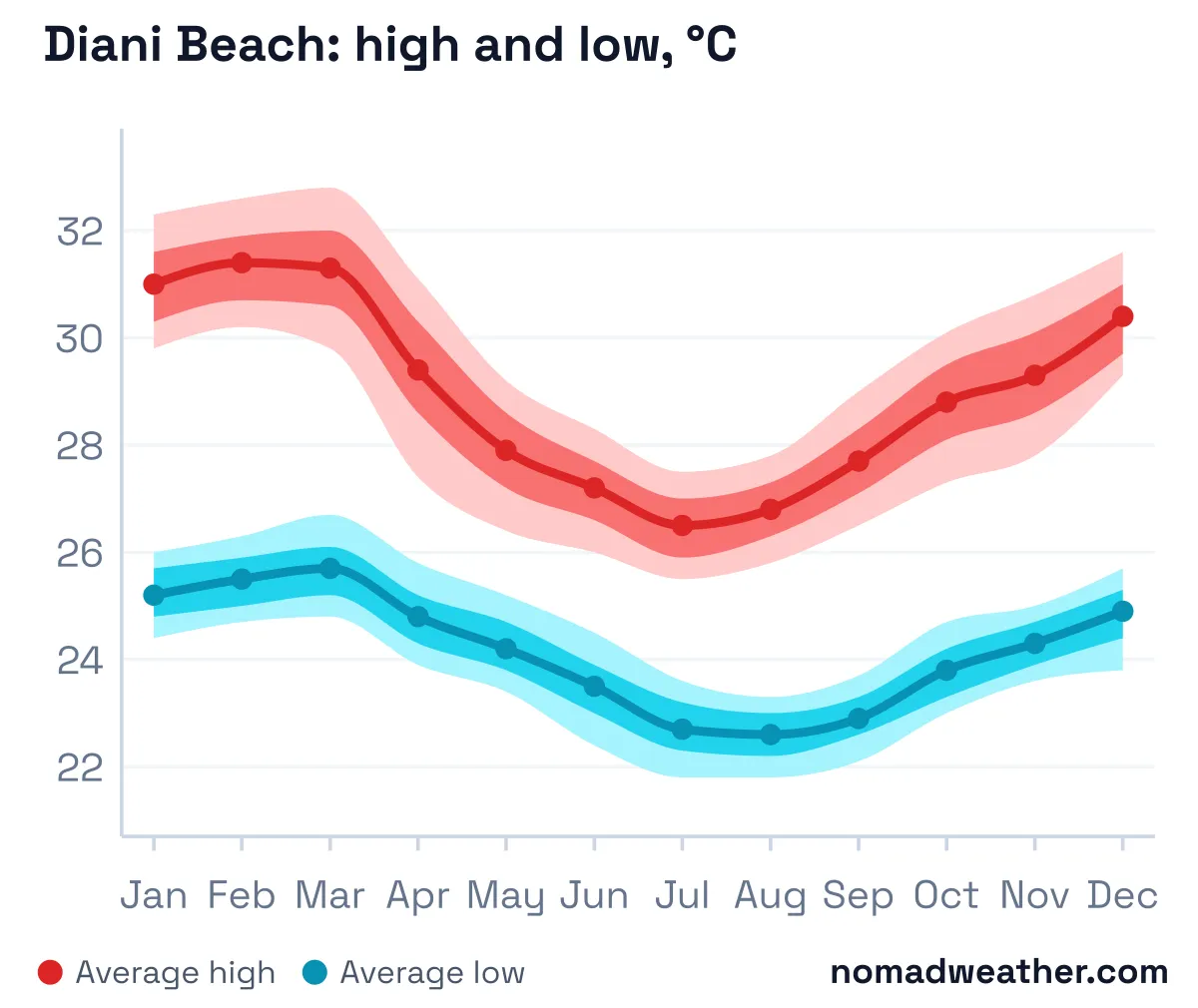
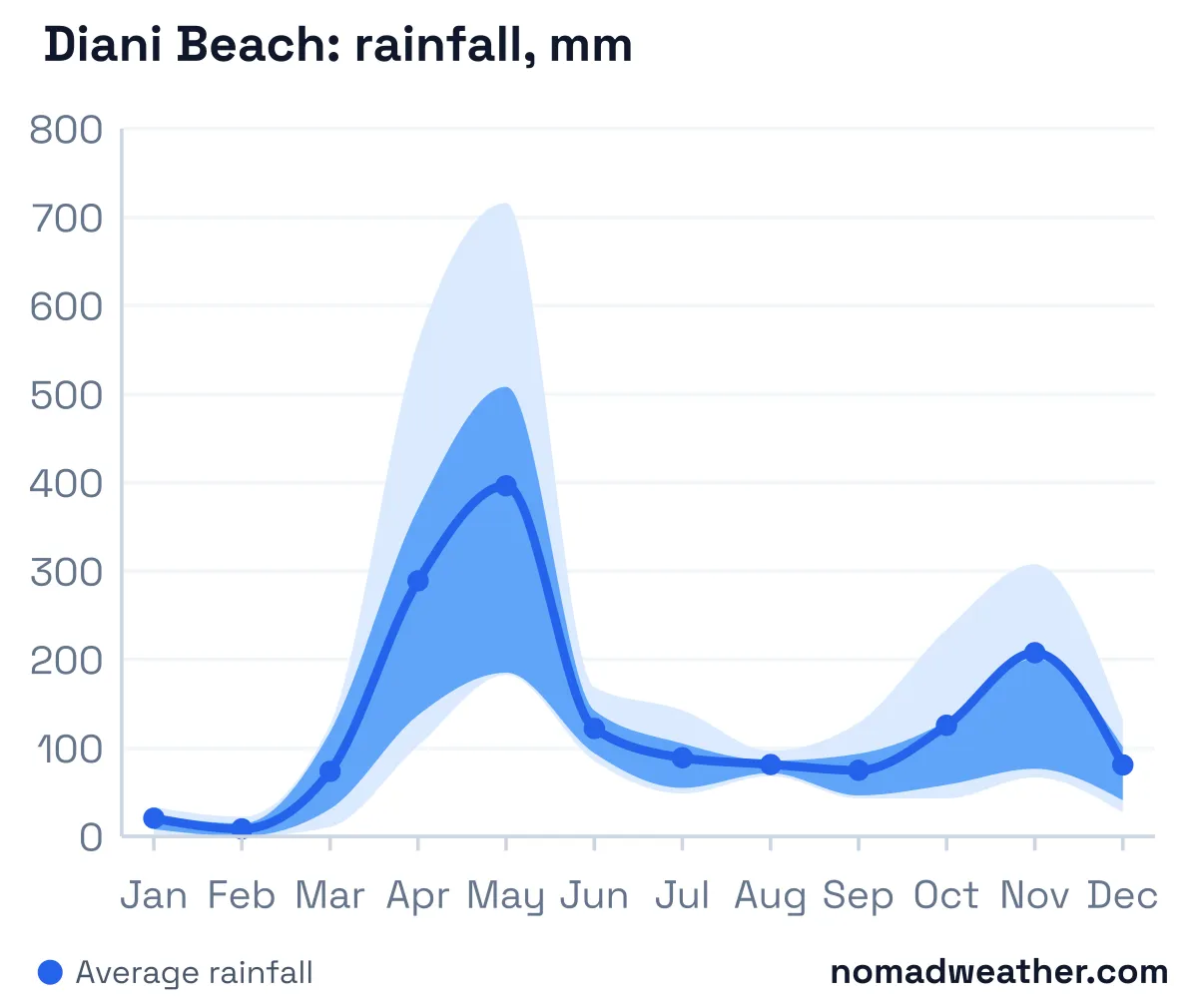
Diani Beach is hot and humid all year, with highs of 27° to 31°. What changes is the rain, and it has two seasons, not one: the long rains in April and May, when it rains on about half the days, and the short rains in November. January and February are the driest, hottest months, and June to October is a cooler, mostly dry stretch. Here is the year; a rainy day is a day with at least four millimetres, so a brief shower does not count:
Diani Beach: Average high and low temperature, °C
Diani Beach: Rainfall, mm
Averages 2015-2025 · Source: Open-Meteo, CHIRPS · How we measure
Read the rain line first: one huge peak in April and May, a smaller bump in November, and the rest low. The temperature band drops by about four degrees in the middle of the year. For one month at a time, the Diani Beach page is quicker.
Where to be next: your month-by-month route, $19
A route for your months with a leave-by date for each stop, a backup, and the seasonal traps on your path. Drafted from 11 years of weather data, every number checked against it, in your inbox within 48 hours. Not included: visas, insurance or bookings.
Which months are driest and best?
January and February. January has a 31° high, a 25° night and 21 mm of rain on about 2 days. February is the driest month, at 9 mm on about 1 day, and the clearest, hottest time at the coast.
March is still hot (31°) but the rain is coming back, with 74 mm on about 6 days. It is the start of the transition, and in some years the long rains arrive early.
If your priority is dry and hot, choose January and February. If you prefer less heat and can live with some wind, August and September are the driest of the cooler months, at 81 and 75 mm on 4 and 3 days, with highs of 27° to 28° and cloud under 50 percent.
When are the long rains?
April and May, by a distance. April has about 14 rainy days and 289 mm; May has about 14 and 397 mm, the wettest month in our data. Cloud covers 66 to 72 percent of the sky and humidity peaks at 83 percent. June is the end of it, with 122 mm. Avoid April and May unless you want low season and heavy storms; many places shut or discount.
When are the short rains?
November, with a tail into December. November has 208 mm on about 7 rainy days; October (126 mm) is the build-up. December drops to 81 mm but still counts about 8 rainy days, so December is not a reliable dry month, whatever the high-season prices suggest. The short rains are about half the size of the long rains: 208 mm in November against 397 mm in May.
What about the wind and the sea?
From May to July the wind is at its strongest, around 5 m/s on average against about 3 m/s in November and December. That is the south-east monsoon blowing. We hold wind averages, not sea conditions, so we cannot tell you about swell, seaweed or visibility for diving; check a local report for that.
How does Diani compare with other winter-sun bases?
Diani is hot in January and February with almost no rain. Here it is next to Cape Verde, the Atlantic alternative:
January, February and March averages, side by side
| Place | High | Low | Rain | Rain days |
|---|---|---|---|---|
| Diani Beach Jan | 31° | 25° | 21 mm | 2 |
| Diani Beach Feb | 31° | 26° | 9 mm | 1 |
| Diani Beach Mar | 31° | 26° | 74 mm | 6 |
| Cape Verde Jan | 26° | 20° | 4 mm | 0 |
| Cape Verde Feb | 25° | 20° | 4 mm | 0 |
| Cape Verde Mar | 26° | 19° | <1 mm | 0 |
Averages 2015-2025 · Source: Open-Meteo, CHIRPS · How we measure
Cape Verde is several degrees cooler and stays dry through March. Diani is hotter and more humid, with the rain returning earlier. See Cape Verde weather by month for the Atlantic option, and Cape Town for the southern summer. For the world in January, see where is warm in January.
What would we do?
Come in January or February and plan work for early morning and evening, with air conditioning or at least a fan at night. These are also the busy months, so book ahead. Treat March and October as the edges and expect them to shift from year to year. In the long rains, storms can cause power and internet cuts, so ask your host about a backup. Weather is only part of a base here: the month you choose also changes what you pay and what is open.
How sure are these numbers?
They are month-of-year averages for one point at Diani Beach, from stored climate data (Open-Meteo archive, 2015 to 2025). The rains can start early or late in any one year, so a month near a season boundary (March, October, November) is the least certain. Other sources give different totals because they use different stations and years. This page is weather only; check prices and conditions separately.
Frequently asked questions
What is the best month to visit Diani Beach for weather?
February, then January. February has about 1 rain day and 9 mm, January about 2 rain days and 21 mm, both with highs of 31°C and nights of 25°C. It is also the hottest, humid time of the year.
When is the rainy season in Diani Beach?
There are two. The long rains are April and May, when we see about 14 rain days a month and 289 mm in April and 397 mm in May. The short rains are in November, about 7 rain days and 208 mm, with a tail of 81 mm in December.
Is December dry in Diani Beach?
Less rain than November in total, but not dry: about 8 rain days and 81 mm, with highs of 30°C. December is not the clean stretch that January and February are.
Is June to September a good time for Diani Beach?
It is the cooler, drier part of the year: highs of 26°C to 28°C and 3 to 8 rain days a month, with August and September the driest at 4 and 3 rain days. It is also the windiest time, with average wind speeds at their highest in May to July.
Is Diani Beach humid?
Yes, all year: 76 to 83 percent average relative humidity. It is highest in April and November, the rainy months.
Not sure where yet? Pick your months and what to avoid, and get your 3 best places → Where should I go?
Weather data: Open-Meteo (CC BY 4.0), open-meteo.com; rain totals: CHIRPS (Climate Hazards Center, UC Santa Barbara). Processed by NomadWeather from stored copies of the data.