

What is the weather in Ubud by month?
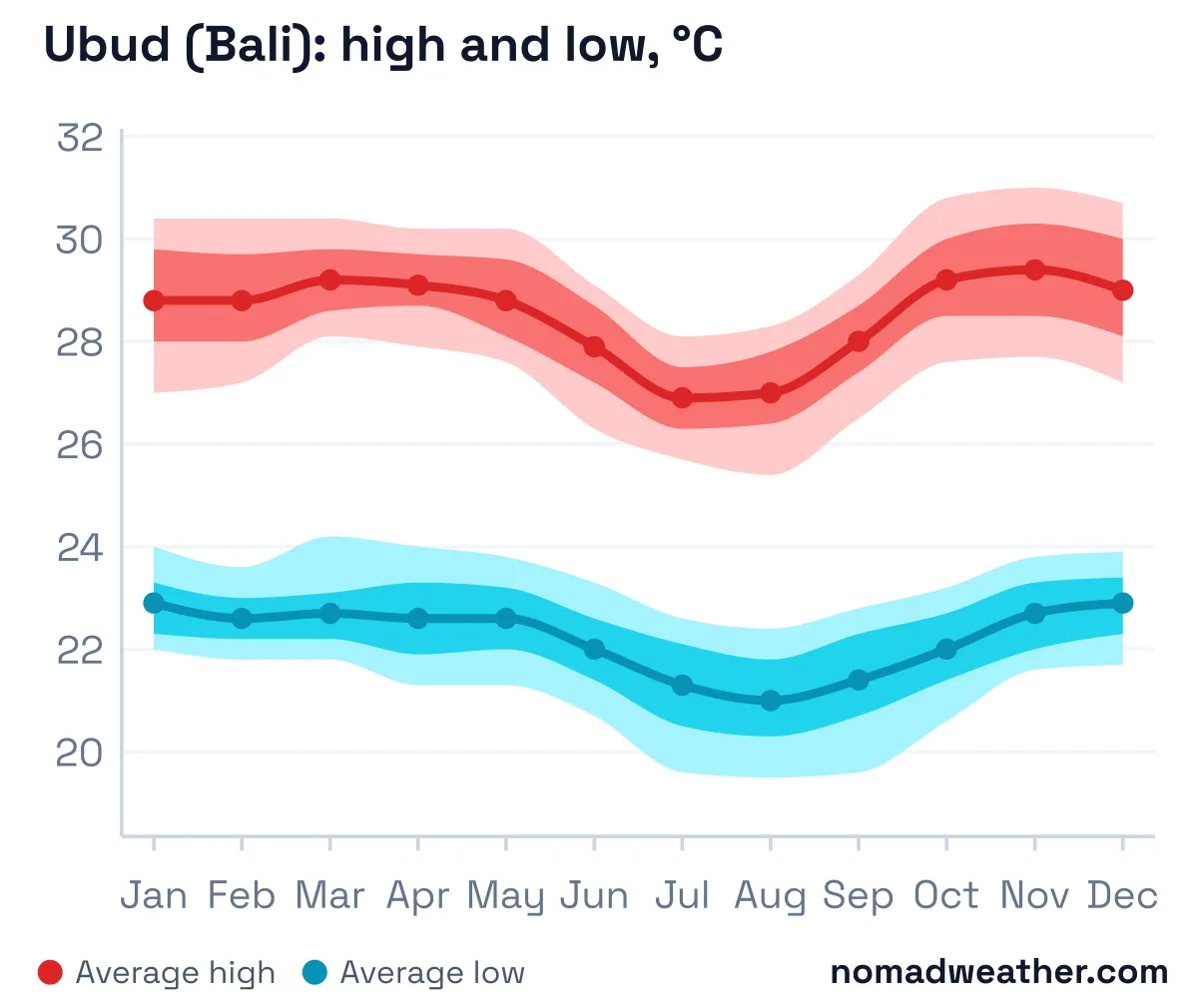
Warm every month, wet most of them. Ubud has highs of 27° to 29° and nights of 21° to 23° all year, so temperature never decides the month. Rain does. The year has one long wet block and a shallow dry one:
Ubud (Bali): Average high and low temperature, °C
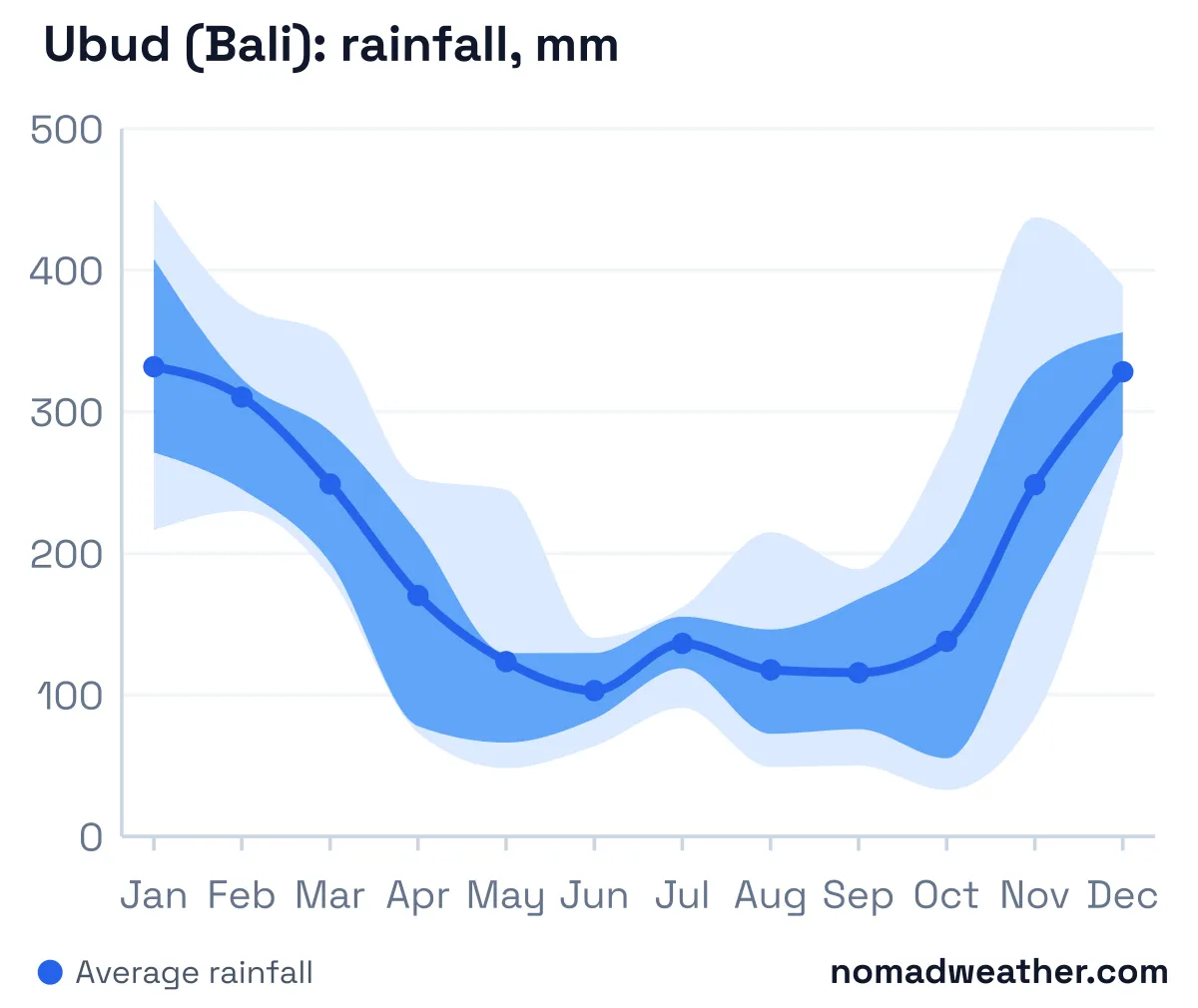
Ubud (Bali): Rainfall, mm
Averages 2015-2025 · Source: Open-Meteo · How we measure
Read the rain line. The wet season runs from November to March and peaks from December to February, when rain falls on most days. April and May ease off, and June to September sit between 103 and 136 mm. If you are choosing between months, the real step is between October (138 mm) and November (249 mm), the jump from the dry half to the wet half.
Where to be next: your month-by-month route, $19
A route for your months with a leave-by date for each stop, a backup, and the seasonal traps on your path. Drafted from 11 years of weather data, every number checked against it, in your inbox within 48 hours. Not included: visas, insurance or bookings.
Is Ubud wetter than the coast?
Yes, in every month, and most of all in the dry season. Ubud sits inland and uphill, where clouds build against the slopes. Here is the comparison with Canggu in the driest, a shoulder and the wettest month:
August, November and January averages, side by side
| Place | High | Low | Rain | Rain days |
|---|---|---|---|---|
| Ubud Aug | 27° | 21° | 118 mm | 9 |
| Ubud Nov | 29° | 23° | 249 mm | 18 |
| Ubud Jan | 29° | 23° | 332 mm | 21 |
| Canggu Aug | 28° | 23° | 56 mm | 4 |
| Canggu Nov | 30° | 24° | 204 mm | 15 |
| Canggu Jan | 29° | 25° | 313 mm | 19 |
Averages 2015-2025 · Source: Open-Meteo · How we measure
In August Ubud gets more than double the coast's rain. In January the gap closes, because the whole island is wet. So if you leave the coast for Ubud in the "dry" months, take a rain jacket. The three-way comparison with Uluwatu is in Canggu vs Uluwatu vs Ubud.
How humid is Ubud?
Between 84 and 88 percent in every month. The wet season is the most humid, and the dry season is only a few points lower. Cloud follows rain, from about nine tenths of the sky in January to about seven tenths from June to September. Humidity is why laundry takes days to dry and why a damp flat can smell of mould, in any month, so air conditioning or a dehumidifier is part of the rent decision. Ask the host how the flat copes in January, when it stays damp for weeks, and whether the wifi survives a thunderstorm.
When are the rice terraces worth the wet?
It depends what you want. The terraces are greenest when it has been raining, so the wet months look best in a photo. The dry months give you the most hours to walk them without a downpour. April and May are the compromise: still green after the wet season, with rain down to 170 and 124 mm.

If you go from December to February, plan the walk for the morning and keep the afternoon for work.
What about August? Does it really rain in Ubud then?
Some, yes, but less than a model suggests at first glance. Our August figure is 118 mm, with rain on about 9 days. Other weather sites put August lower, some under half our number, because our totals come from a weather model and not from a gauge in the town. Model rain in the hills reads wet in the dry season, which is why we use these figures to compare Ubud with the coast and not to promise an afternoon. The effect is much larger on rain days: see why a weather model says Bali rains 25 days in August. Our reading: August in Ubud is the dry season, with some short downpours, and the chart above shows how shallow that dry season is: the lowest bar is still 103 mm.
Which month should I pick?
- Driest and cooler nights: June to September. June is the lowest at 103 mm; July and August have the coolest nights (21°).
- Best balance: April to May for green terraces and easing rain, or September to October before the wet season arrives.
- Wet but fine for work: December to February. Heavy cloud and humidity near 87 percent. Many nomads stay, with a good internet backup.
- Avoid if you hate rain: January, the wettest at 332 mm.
For the island-wide calendar see Bali rainy season month by month and the best time to visit Bali by area.
How we got these numbers
Eleven years of weather averaged by month for one point at Ubud: rain totals, temperatures, humidity and cloud from the Open-Meteo archive (CC BY 4.0). A rainy day is a day with at least four millimetres of rain, the bar we use in the tropics. It is weather only, not prices, crowds or traffic. Check a current forecast before you travel. See Data Sources.
Frequently asked questions
What is the driest month in Ubud?
June, with 103 mm in our data, followed by September and August (116 mm and 118 mm). Dry here means about a third of the month with rain, not no rain.
What is the wettest month in Ubud?
January, with 332 mm. December (328 mm) and February (310 mm) are almost as wet, so treat December to February as one wet block.
Is Ubud wetter than Canggu?
Yes, in every month. In August Ubud gets 118 mm against 56 mm in Canggu, and in November 249 mm against 204 mm. The gap is smallest in January and February.
Is Ubud humid?
Yes, all year. Average humidity stays between 84 and 88 percent, so the dry season is less rainy but not less sticky.
Is Ubud cooler than the coast?
At night, a little. Lows are 21°C to 23°C, against 23°C to 26°C on the coast, and highs are about the same at 27°C to 29°C.
When are the rice terraces worth visiting?
June to September if you want the most dry hours. The terraces are greenest in the wet months, so April and May, when the rain is easing, are a good compromise.
Not sure where yet? Pick your months and what to avoid, and get your 3 best places → Where should I go?
Weather data: Open-Meteo (CC BY 4.0), open-meteo.com; rain totals: Open-Meteo. Processed by NomadWeather from stored copies of the data.