
Is Sri Lanka's south coast good from January to April?
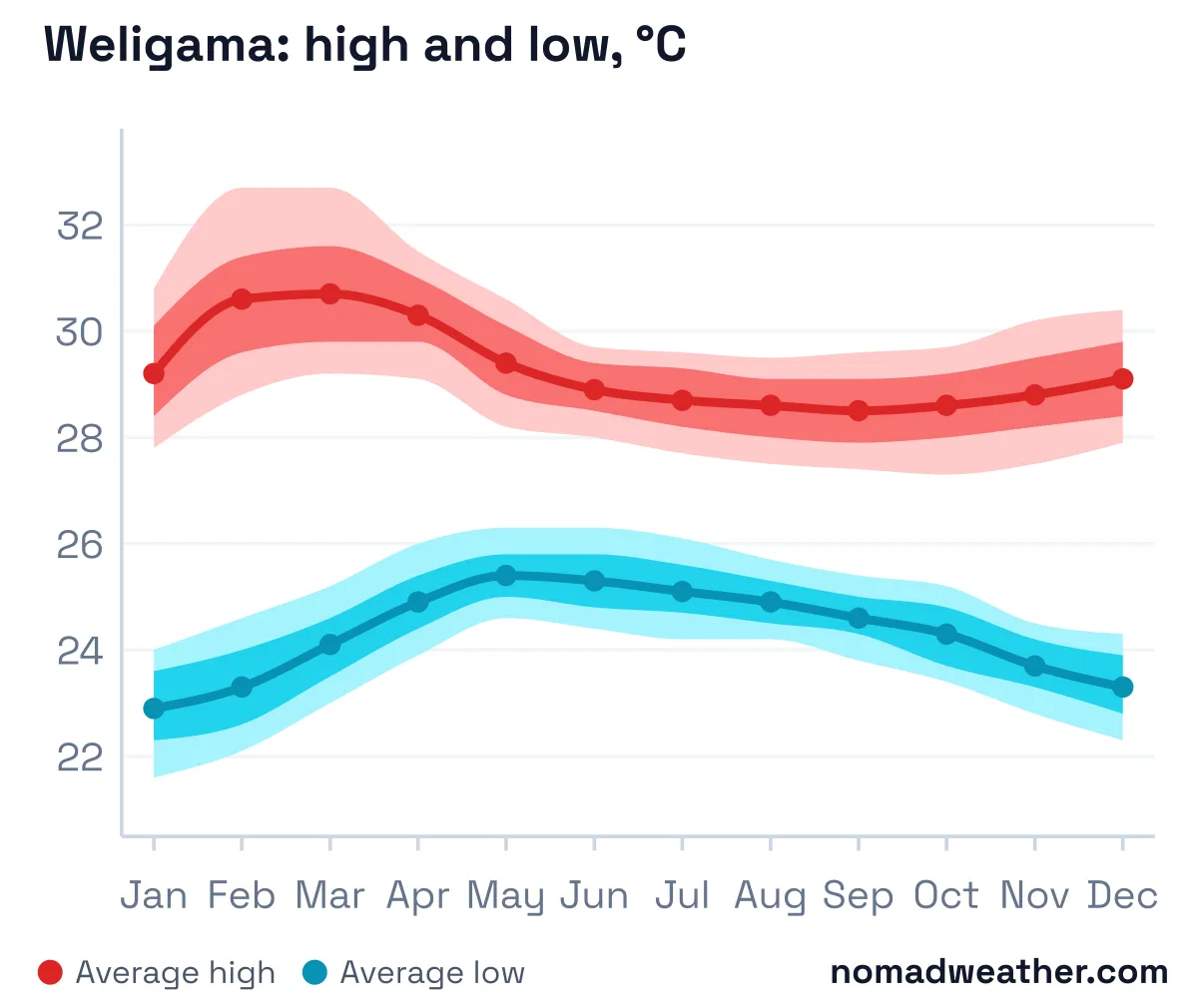
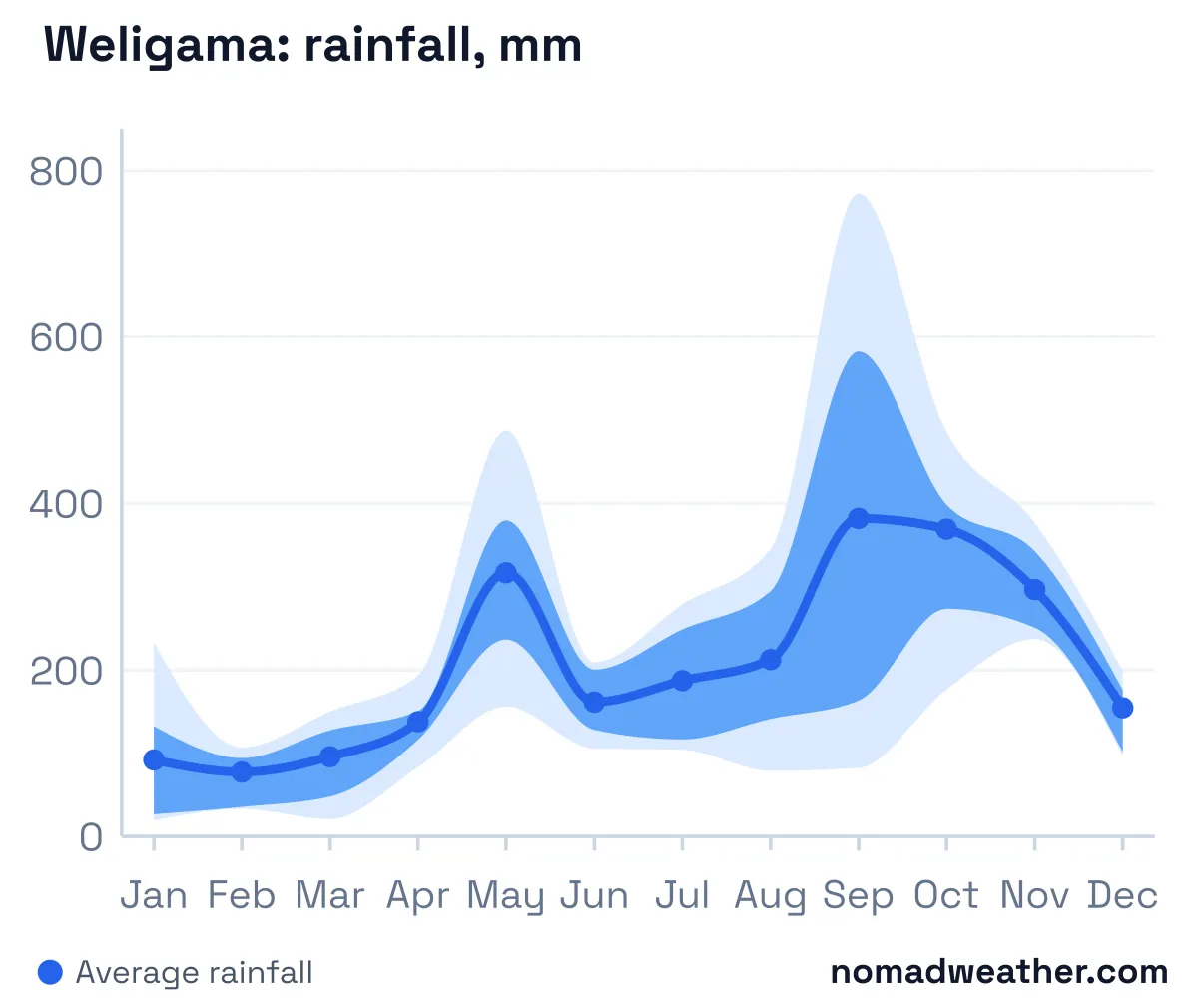
January to March, yes. April, only partly. At Weligama and Ahangama, the south-coast bases most nomads choose, those three months are warm (highs of 29° to 31°) with a mix of sun and cloud and a manageable amount of rain. Guides list "December to April", but December still has 154 mm and April is already the start of the inter-monsoon, so we read it as January to March with shoulders either side.
Weligama: Average high and low temperature, °C
Weligama: Rainfall, mm
Averages 2015-2025 · Source: Open-Meteo, CHIRPS · How we measure
Read the rain line: the three low months are the window. February is the driest, with rain on about 7 of 28 days, the fewest of the three. January is a little cloudier (rain on about 8 of 31 days) and March the warmest at 31° (about 9 of 31 days). Weligama and Ahangama are about 5 km apart and share one weather grid, so the chart applies to both; the rain totals differ by a few millimetres, and by 14 in April.
Nights stay warm at 23° to 25°, and cloud covers about 55% to 65% of the sky in the window, so expect sun on most days but rarely a clear one. That suits working outdoors in the morning and moving inside when the heat and cloud build up in the afternoon, which is also when the occasional storm arrives.
Where to be next: your month-by-month route, $19
A route for your months with a leave-by date for each stop, a backup, and the seasonal traps on your path. Drafted from 11 years of weather data, every number checked against it, in your inbox within 48 hours. Not included: visas, insurance or bookings.
Is December part of the south coast season?
Not the dry part. December has about two thirds more rain than January, on about 14 of 31 days against about 8, and November is far wetter at 291 to 297 mm. If your plan says "Sri Lanka from December", expect a wet first month and a good one from January. Our December and January lists agree: the south coast belongs to the January group.
What happens in April and May?
The south-west monsoon arrives on this coast earlier than most people expect. April has 138 mm at Weligama and 152 mm at Ahangama, about half as much again as March, with rain on about 13 of 30 days: an afternoon or evening storm on about two days in five. It is not a washout, but plan outdoor work around it. May is the wettest month of the run at 317 to 323 mm.
If you want more dry weather after March, the table shows how the Gulf of Thailand and Bangkok compare in April.
April averages, side by side
| Place | High | Low | Rain | Rain days |
|---|---|---|---|---|
| Weligama | 30° | 25° | 138 mm | 13 |
| Koh Samui | 31° | 27° | 90 mm | 5 |
| Phuket | 32° | 26° | 125 mm | 8 |
| Bangkok | 34° | 27° | 69 mm | 7 |
Averages 2015-2025 · Source: Open-Meteo, CHIRPS · How we measure
What do remote workers do about the wet months?
- Staying through the spring: put heavy outdoor days, surf and scooter trips in January to March. By April, treat afternoons as indoor work time.
- Want more dry weather after March: the east coast of Sri Lanka dries out as the south-west gets wetter. We hold no east-coast data, so no numbers, but this regional guide describes the east as wetter in January and February and drier from April. It is a lead to check, not a recommendation from our data.
- Want a dry place from February to April: compare where is warm in February and where is warm in March, where the dry, warm list is broader.
Does the rain share matter if the total is low?
A little. From January to March a proper rain day comes on roughly one day in four, and the totals are only 76 to 100 mm: a few wet spells with long dry runs between them. In April it is closer to two days in five, which is the difference you feel when you schedule calls or a surf session. And a 11-year average hides the year: a February with 77 mm on average can be very dry or rather showery, and the monsoon timing shifts. We do not forecast a specific year.
A note on the numbers
All figures are 11-year averages for each destination's coordinates, grouped by calendar month. Rain totals come from CHIRPS (satellite and rain-gauge data); rain days, temperatures and cloud come from the Open-Meteo archive. A rain day is a day with at least four millimetres of rain (the tropics rule), which matches what rain gauges count, so light drizzle does not count: read it alongside millimetres. Weather only: no prices, crowds, sea state, swell or wind, which matter a lot on this coast for swimming and surfing. See Data Sources.
Frequently asked questions
What is the best month for Weligama or Ahangama?
February has the lowest rainfall in our data, about 77 mm, with an average high of 31°C. January (92 mm) and March (96 to 100 mm) are a little wetter.
Is April a good month for Sri Lanka's south coast?
It is the start of the change. April rainfall is 138 to 152 mm, about half as much again as March, and rain days rise to about 13 of 30 days, against about 7 of 28 days to about 9 of 31 days in January to March. Highs stay near 30°C, so it is warm and showery rather than cold.
Are Weligama and Ahangama different in weather?
Barely. They are about 5 km apart and share the same weather-model grid cell, so temperatures, cloud and rain days are identical. Rain totals are sampled separately and differ by a few millimetres in most months and by 14 in April, so the numbers on this page apply to both. Surf spots and beaches differ more than the climate.
Is December part of the dry season on the south coast?
Not really. December has about 154 mm of rain, about two thirds more than January, and rain on about 14 of 31 days against about 8 of 31 days in January. November is much wetter at 291 to 297 mm.
How sunny is the south coast from January to March?
Cloud cover is moderate, about 55% to 65% in January to March, so you get a mix of sun and cloud. Average lows of 23 to 25°C keep nights warm.
Not sure where yet? Pick your months and what to avoid, and get your 3 best places → Where should I go?
Weather data: Open-Meteo (CC BY 4.0), open-meteo.com; rain totals: CHIRPS (Climate Hazards Center, UC Santa Barbara). Processed by NomadWeather from stored copies of the data.