

The best time to visit Koh Samui and Koh Phangan is February to March, the driest stretch on both islands: March brings 47 mm of rain on Samui and 41 mm on Phangan. Avoid October to December, when the Gulf gets its monsoon: November brings 457 mm on Samui and 433 mm on Phangan. July and August look dry in the totals, but the sky is nearly overcast, with rain on 7 to 8 days of 31 on Samui.
January is still wet on both islands (152 mm on Samui, 154 mm on Phangan), even though most guides count it in a dry season from January to April.
Where to be next: your month-by-month route, $19
A route for your months with a leave-by date for each stop, a backup, and the seasonal traps on your path. Drafted from 11 years of weather data, every number checked against it, in your inbox within 48 hours. Not included: visas, insurance or bookings.
When is the best time to go to Koh Samui and Koh Phangan?
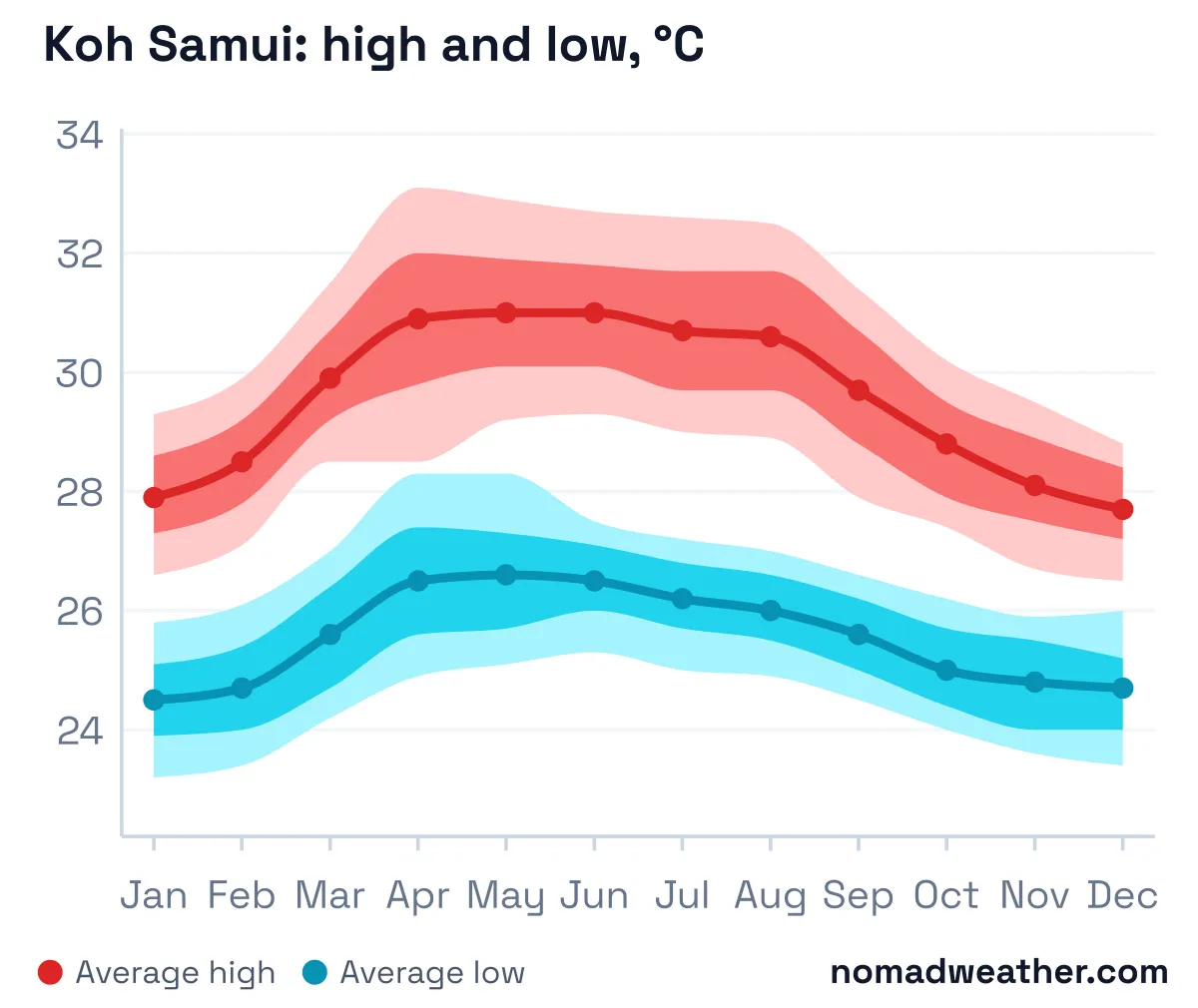
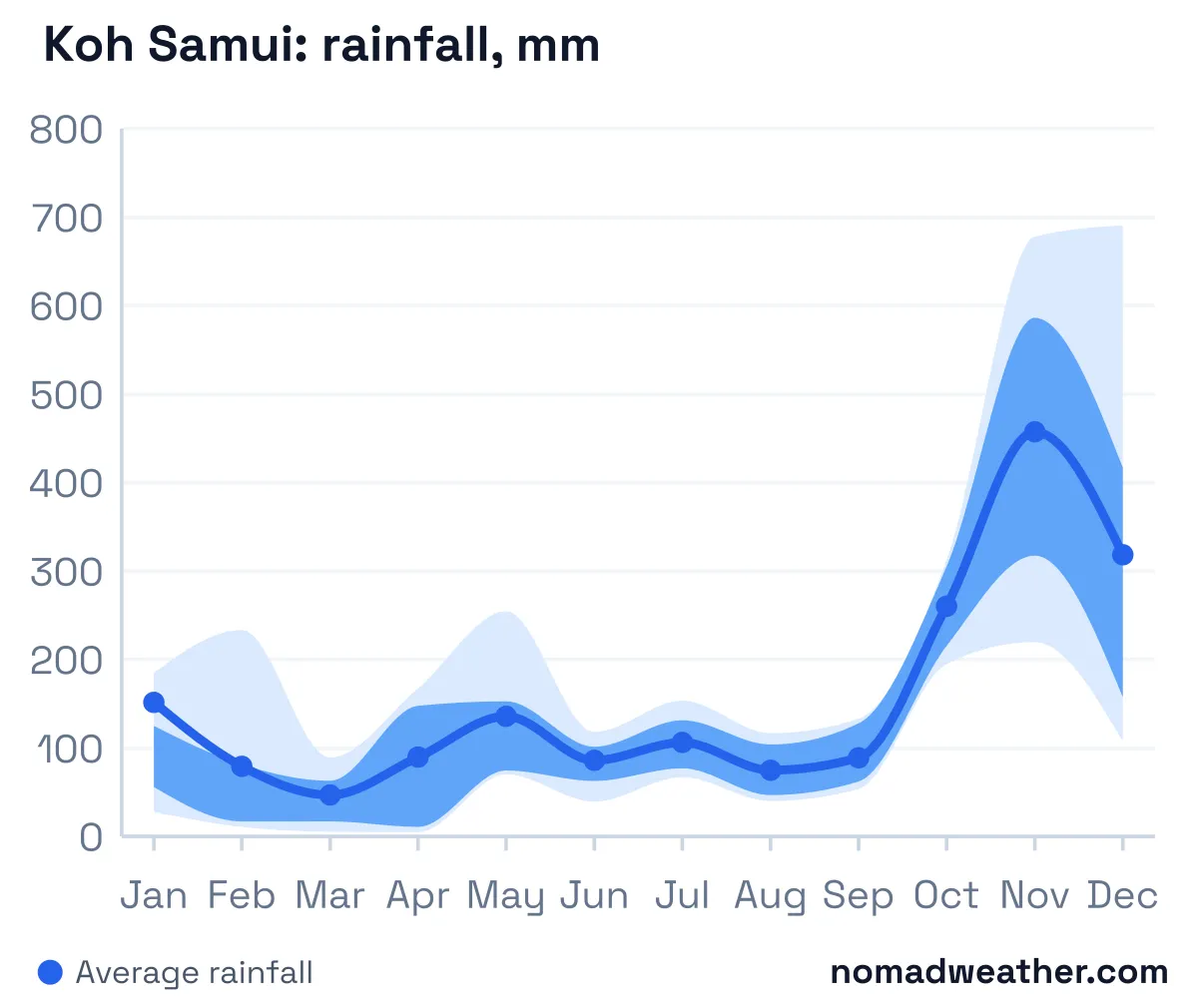
February and March. Here is Samui's year, which the other island follows closely:
Koh Samui: Average high and low temperature, °C
Koh Samui: Rainfall, mm
Averages 2015-2025 · Source: Open-Meteo, CHIRPS · How we measure
Read the rain line: a dry stretch from February to April, a lower hump from May to September, and the big peak from October to December that tops out in November. Cloud falls to about half the sky in February and March, and rain falls on only 2 to 4 days of 28 to 31, so what February brings comes in a few bursts, not spread across the month. Highs are 28° to 30°, warm without the heat of April and May. For one month at a time, see the Koh Samui and Koh Phangan pages.
How wet are October and November really?
They are the wet season, and November is its peak by a wide margin: 260 mm in October and 457 mm in November on Samui, 286 mm and 433 mm on Phangan. December is still wet (318 mm and 286 mm), though rain falls on far fewer days. In October and November it rains on about 18 of 30 to 31 days on Samui, so this is not the pattern of a short afternoon shower. If you want to work from the islands in this window, plan for cloud and wind on most days and a good indoor workspace.
Both islands sit on the Gulf side of Thailand, which gets its heaviest rain late in the year, after the Andaman coast has begun to dry out. Our three coasts guide lays out the month-by-month swap.
Are July and August the second dry season?
Not really, and this is where many guides go wrong. The weather is warm, at 31° on Samui in both months. But cloud averages about 89 percent across both months, nearly an overcast sky from morning to night, and rain falls on about 8 days in July and 7 in August on Samui, about double the 2 to 4 days of February and March. Totals are not what sets these months apart: August has 75 mm on Samui, no wetter than February. The difference is that the rain comes on two to four times as many days, under a heavy sky. So it is a fair time for a beach month on Samui if you accept grey skies, and a poor one if you expect the clear, bright weather of February.
Is Koh Phangan wetter than Koh Samui?
On rain days, yes, from April to October; on totals the two islands are close and take turns. Phangan has rain on more days, with the biggest gaps in July (about 12 days against 8) and September (about 14 against 10). Samui is wetter at the peak, in November and December. Here are the two islands side by side in the months that decide the choice:
February, March, July, September, November and December averages, side by side
| Place | High | Low | Rain | Rain days |
|---|---|---|---|---|
| Koh Samui Feb | 29° | 25° | 79 mm | 4 |
| Koh Samui Mar | 30° | 26° | 47 mm | 2 |
| Koh Samui Jul | 31° | 26° | 106 mm | 8 |
| Koh Samui Sep | 30° | 26° | 89 mm | 10 |
| Koh Samui Nov | 28° | 25° | 457 mm | 18 |
| Koh Samui Dec | 28° | 25° | 318 mm | 10 |
| Koh Phangan Feb | 28° | 26° | 86 mm | 2 |
| Koh Phangan Mar | 29° | 26° | 41 mm | 2 |
| Koh Phangan Jul | 29° | 27° | 124 mm | 12 |
| Koh Phangan Sep | 29° | 26° | 116 mm | 14 |
| Koh Phangan Nov | 28° | 25° | 433 mm | 17 |
| Koh Phangan Dec | 28° | 25° | 286 mm | 9 |
Averages 2015-2025 · Source: Open-Meteo, CHIRPS · How we measure
If rain days are your main worry, Samui is the safer pick from April to October. In November and December neither island is a good bet, and Phangan's slightly lower totals do not change that. In February or March either island works, and you can choose on the place, not the weather.
Is January a safe choice?
January is the shoulder, and a wetter one than its rain days suggest. Samui gets 152 mm and Phangan 154 mm, just over the line we call a wet month, but with rain on only about 5 and 4 of 31 days, so it comes as a few heavy days rather than a grey month. Highs are 28°, among the coolest of the year along with December. It is clearly better than December, with about half the rain, and the drying trend continues into February. If your dates are fixed and you cannot wait for February, January is a fair compromise.
Do not read this as a promise for a particular week. These are averages over eleven years, so any given January can be drier or wetter. They give the odds: January is a fair bet that improves through the month, February and March are the best odds you will get, and October and November are poor odds on both islands.
What would we do?
For a month of work with beach time, book February or March. If you must go in the second half of the year, choose June to August over September to November, and pick Samui over Phangan. December is still wet: January is the better start, and the February guide shows which places beat the Gulf islands for dry warm weather. To set Koh Phangan against the Andaman coast month by month, see Koh Lanta, Phuket, Krabi or Koh Phangan, December to March.
How sure are these numbers?
Rain totals come from CHIRPS, which blends satellite rainfall with rain-gauge data; rain days, temperatures and cloud come from Open-Meteo. We checked the totals against the long-term station normal for Koh Samui quoted on Wikipedia. The shape is the same: November is the wettest month by a wide margin, October and December follow, and February to April is the drier stretch. The sources differ in two places: the station has more rain in October than in December, ours the other way round, so treat all three months as wet; and our 2015-2025 record puts March as the driest month while the station shows March wetter than February or April, so treat February to April as the dry stretch and do not plan around one best month inside it. The grid data also gives daily highs about one to two degrees below a station thermometer. A rainy day is a day with at least four millimetres of rain, the level that matches what rain gauges count in the tropics, so drizzle does not add to the count.
Frequently asked questions
What is the best month to visit Koh Samui?
March is the driest month in our record at 47 mm, with rain on about 2 of 31 days. February has more rain (79 mm) but on only about 4 of 28 days. Both also have the lowest cloud cover of the year, around half the sky.
What is the wettest month on Koh Phangan?
November, at 433 mm of rain on about 17 of 30 days. October and December follow at 286 mm each, October with rain on more days (about 20 of 31 days) and December on far fewer (about 9 of 31 days).
Is July or August a good time for Koh Samui?
It is hot (a 31°C high in July) and usually fine for the beach, but rain falls on about 8 of 31 days, July brings 106 mm, and the sky is nearly overcast (cloud cover about 89%).
Is Koh Phangan wetter than Koh Samui?
On rain days, yes, from April to October: in September rain falls on about 14 of 30 days on Phangan against about 10 of 30 days on Samui. On totals the two islands are close and take turns: Phangan is wetter in May (166 mm against 136 mm) and September (116 mm against 89 mm), Samui in November (457 mm against 433 mm) and December (318 mm against 286 mm).
Is December a good month for the Gulf islands?
It is better than November but still wet. Samui gets 318 mm and Phangan 286 mm, with rain on about 10 and 9 of 31 days, so fewer rain days than November but heavy ones. Expect it to improve from January.
Is Samui hot in April and May?
Yes, these are the hottest months, with a 31°C high in April and 31°C in May on Samui. April is still fairly dry at 90 mm, but May turns cloudy with rain on about 9 of 31 days.
Not sure where yet? Pick your months and what to avoid, and get your 3 best places → Where should I go?
Weather data: Open-Meteo (CC BY 4.0), open-meteo.com; rain totals: CHIRPS (Climate Hazards Center, UC Santa Barbara). Processed by NomadWeather from stored copies of the data.