
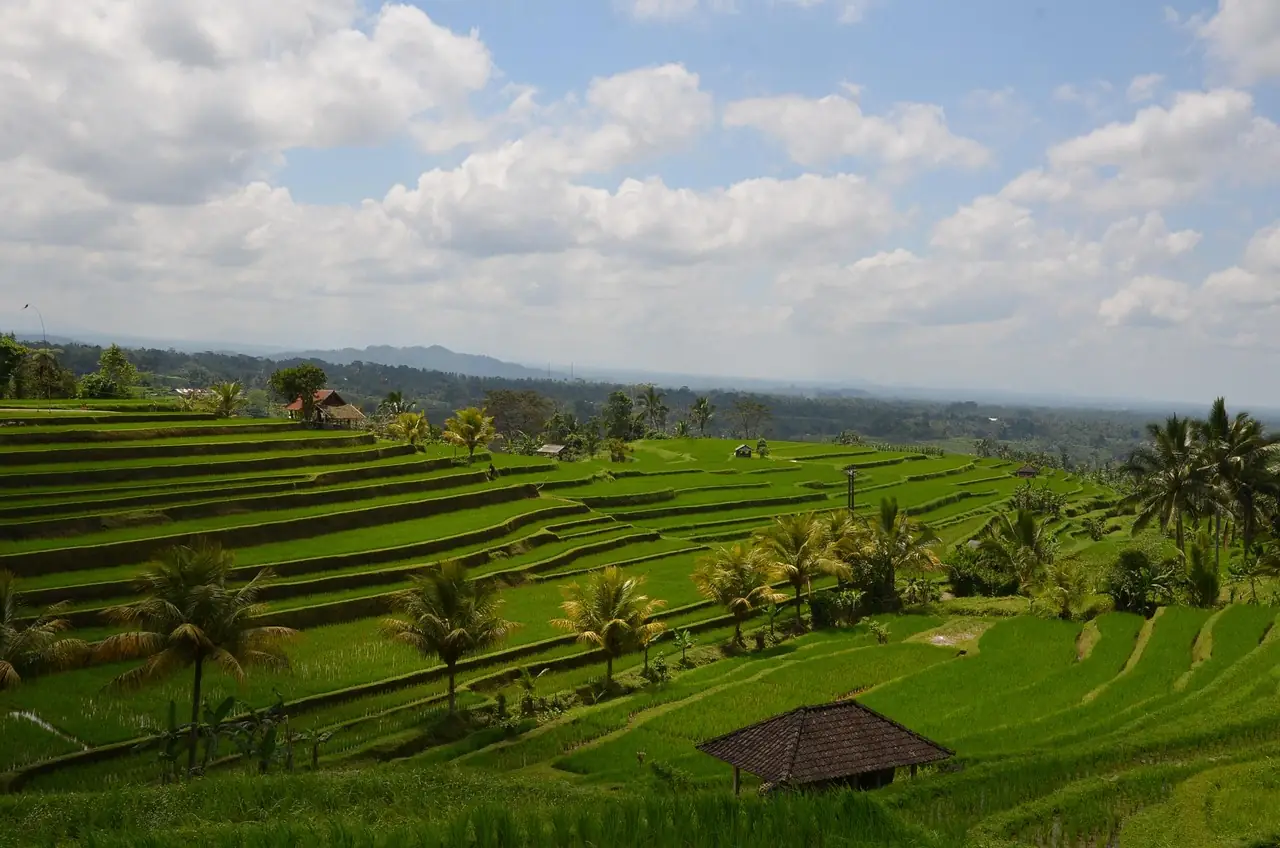
Canggu (Bali) in March: wet, highs 30°C and about 205 mm of rain. Find a stay there →
When does Bali's wet season actually end?
Not on one date. In our 2015 to 2025 averages, Canggu drops from 313 mm of rain in January to 205 mm in March, 154 mm in April and 88 mm in May, then stays under 70 mm from June to August. From our 11-year climate data, as of 27 November 2026. So the answer for a nomad is: March is still wet, April is mixed, and May is dry. Which area you live in moves that by a few weeks.
Rain per month, mm (2015-2025)
| Jan | Feb | Mar | Apr | May | Jun | Jul | Aug | Sep | Oct | Nov | Dec |
|---|---|---|---|---|---|---|---|---|---|---|---|
| Canggu | |||||||||||
| January: 313 | February: 295 | March: 205 | April: 154 | May: 88 | June: 69 | July: 69 | August: 56 | September: 101 | October: 107 | November: 204 | December: 288 |
| Ubud | |||||||||||
| January: 332 | February: 310 | March: 249 | April: 170 | May: 124 | June: 103 | July: 136 | August: 118 | September: 116 | October: 138 | November: 249 | December: 328 |
| Uluwatu | |||||||||||
| January: 391 | February: 355 | March: 261 | April: 108 | May: 85 | June: 72 | July: 47 | August: 17 | September: 70 | October: 121 | November: 227 | December: 338 |
Averages 2015-2025 · Source: Open-Meteo, CHIRPS · How we measure
Where to be next: your month-by-month route, $19
A route for your months with a leave-by date for each stop, a backup, and the seasonal traps on your path. Drafted from 11 years of weather data, every number checked against it, in your inbox within 48 hours. Not included: visas, insurance or bookings.
Which part of Bali dries out first?
Uluwatu, but not in March. March is as wet there as anywhere (261 mm, 14 rainy days), then it falls fastest: 108 mm and 9 rainy days in April, 85 mm and 5 in May. Canggu falls more slowly, from 16 rainy days in March to 11 in April and 7 in May. Ubud is wetter all year: 18 rainy days in March, 12 in April and still 9 in May and June, with 124 mm in May. Its clouds linger, so a laptop room there stays damp after the coast has dried.
Nomads in Canggu describe it as a bowl where clouds stay, and storms that hit one village while the next is sunny. The averages hide that. A practical rule: if the first month matters, pick Uluwatu for April and May, and Canggu or Ubud from June.
Where to be next month, by email
One email at the start of each month: where it's warm, dry and smoke-free next. We'll email you in early December to confirm, then once a month. Free, unsubscribe any time. Privacy
What does each month feel like for work?
- March: the tail of the wet season. Rain on 14 to 18 days a month, humidity at 82 to 87%, and highs near 29°C. Plan a flat with a dry place for laundry and a backup for the wifi in a storm.
- April: the turn. Rain on 9 to 12 days, so most days have a dry window, and the clouds break earlier in the day. Nomads call mid-April onward the start of the good season, though a late wet season can still make April wet.
- May: dry-season weather on the coast: 5 to 7 rainy days, 62% cloud in Canggu and 57% in Uluwatu.
- June: the same or a little better on the coast (5 rainy days).
What should you plan for in March and April?
- Nyepi, 8 March 2027. The whole island shuts for over 24 hours, airport included. See what shuts.
- Rice-field smoke. Nomads report burning after harvests, at the end of February and in March, and again in April to May, depending on how close you live to the fields. Our air data for Canggu stays under 15 µg/m³ in those months, but it is a model that reads low on bad days: see Bali air quality.
- Rents. Nomads report January as cheap and July and August as very expensive, with shoulder months in May and June. Arriving in April or May gets a better price than July.
- A late start. In some years the rains come late, or stay late. The El Niño page covers the 2026-27 forecast.
Where do nomads go while Bali is wet?
The circuit nomads describe: Thai Gulf islands in February and March, Sri Lanka's south coast from January to April, Da Nang from February, then back to Bali in April or May. Chiang Mai works until mid-February, then the burning season starts. Our numbers for March and April (rainy days, rain and highs):
March and April averages, side by side
| Place | High | Low | Rain | Rain days |
|---|---|---|---|---|
| Canggu (Bali) Mar | 30° | 25° | 205 mm | 16 |
| Canggu (Bali) Apr | 30° | 24° | 154 mm | 11 |
| Ahangama Mar | 31° | 24° | 100 mm | 9 |
| Ahangama Apr | 30° | 25° | 152 mm | 13 |
| Koh Phangan Mar | 29° | 26° | 41 mm | 2 |
| Koh Phangan Apr | 30° | 27° | 85 mm | 6 |
| Da Nang Mar | 27° | 22° | 25 mm | 3 |
| Da Nang Apr | 30° | 24° | 28 mm | 3 |
| Chiang Mai Mar | 34° | 21° | 12 mm | 1 |
| Chiang Mai Apr | 35° | 23° | 57 mm | 4 |
Averages 2015-2025 · Source: Open-Meteo, CHIRPS · How we measure
Read it for the turn. Da Nang and Chiang Mai are dry in March and April, but Da Nang gets hot from late April by nomads' reports and Chiang Mai is in its burning season. Koh Phangan is dry in March and turns wetter in May. Ahangama is the one to leave by April, when its rain climbs. For the six-base comparison of January to March, see where to go when Bali is wet. For the whole year as a loop, see the digital nomad calendar.
So when should you land?
- You want dry weather and can pay a little more: May.
- You want lower rents and can take showers: April, in Uluwatu or Canggu.
- You want to avoid Nyepi: arrive after 9 March.
- You cannot wait: January to March is the wettest quarter, so book a flexible month in Canggu or choose Uluwatu.
How sure are these numbers?
Rain totals and rainy days are 2015 to 2025 averages for one point per place from our stored climate data (Open-Meteo archive; rain totals from CHIRPS except Canggu). A given year can be wetter or drier, and El Niño years shift the start of the season. Air is the 2023 to 2025 model mean of PM2.5 from Open-Meteo's air-quality model, which reads low on bad days. Burning, rents and heat timing come from nomad reports, not our data. See Data Sources.
Frequently asked questions
When does Bali's rainy season end?
Gradually, between March and May. Canggu averages 205 mm in March, 154 in April and 88 in May. May is the first month that looks like the dry season, and it is drier than April in Canggu and Uluwatu.
Is April still rainy in Bali?
Less, but yes. Canggu averages 154 mm in April and Ubud 170 mm, against 108 mm in Uluwatu. Rain comes as showers and storms with sunny spells in between. Some years the rains come late and April stays wet.
What is the best month to arrive in Bali as a digital nomad?
May, if you want dry weather: Canggu 88 mm, Uluwatu 85 mm, before the July and August rents peak. April is cheaper and drier than March, with more showers.
Does Bali get less rain in 2027 because of El Niño?
Forecasts say the 2026-27 wet season starts late, not that it is dry. We cannot know the March to May totals in advance, so treat the averages as the typical year. See our El Niño page.
Where can I work from while waiting for Bali to dry out?
Nomads wait in Sri Lanka's south coast, the Thai Gulf islands in February and March, or Da Nang from February. Avoid Chiang Mai from mid-February, when the burning season starts.
Not sure where yet? Pick your months and what to avoid, and get your 3 best places → Where should I go?
Weather data: Open-Meteo (CC BY 4.0), open-meteo.com; rain totals: CHIRPS (Climate Hazards Center, UC Santa Barbara); Canggu (Bali) and Ubud (Bali): Open-Meteo. Processed by NomadWeather from stored copies of the data.