
What is the weather in Krabi and Koh Lanta, in one minute?
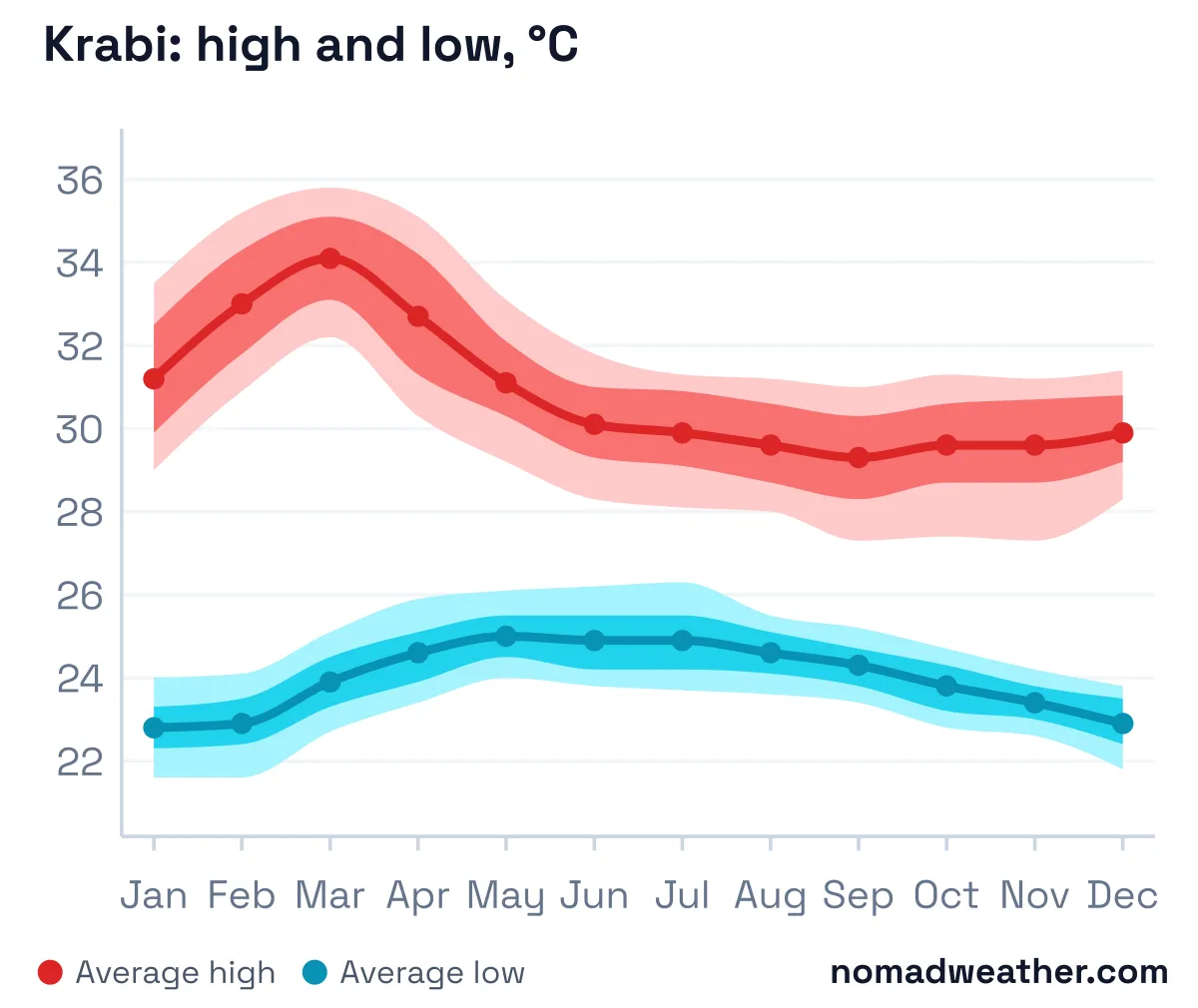
Both sit on Thailand's Andaman coast, about 60 km apart, and they share one year: a dry season from January to March, a green season from May to October, and shoulder months either side. Temperatures stay within a few degrees all year, so the real difference is rain and cloud, not heat. Here is Krabi's year:
Krabi: Average high and low temperature, °C
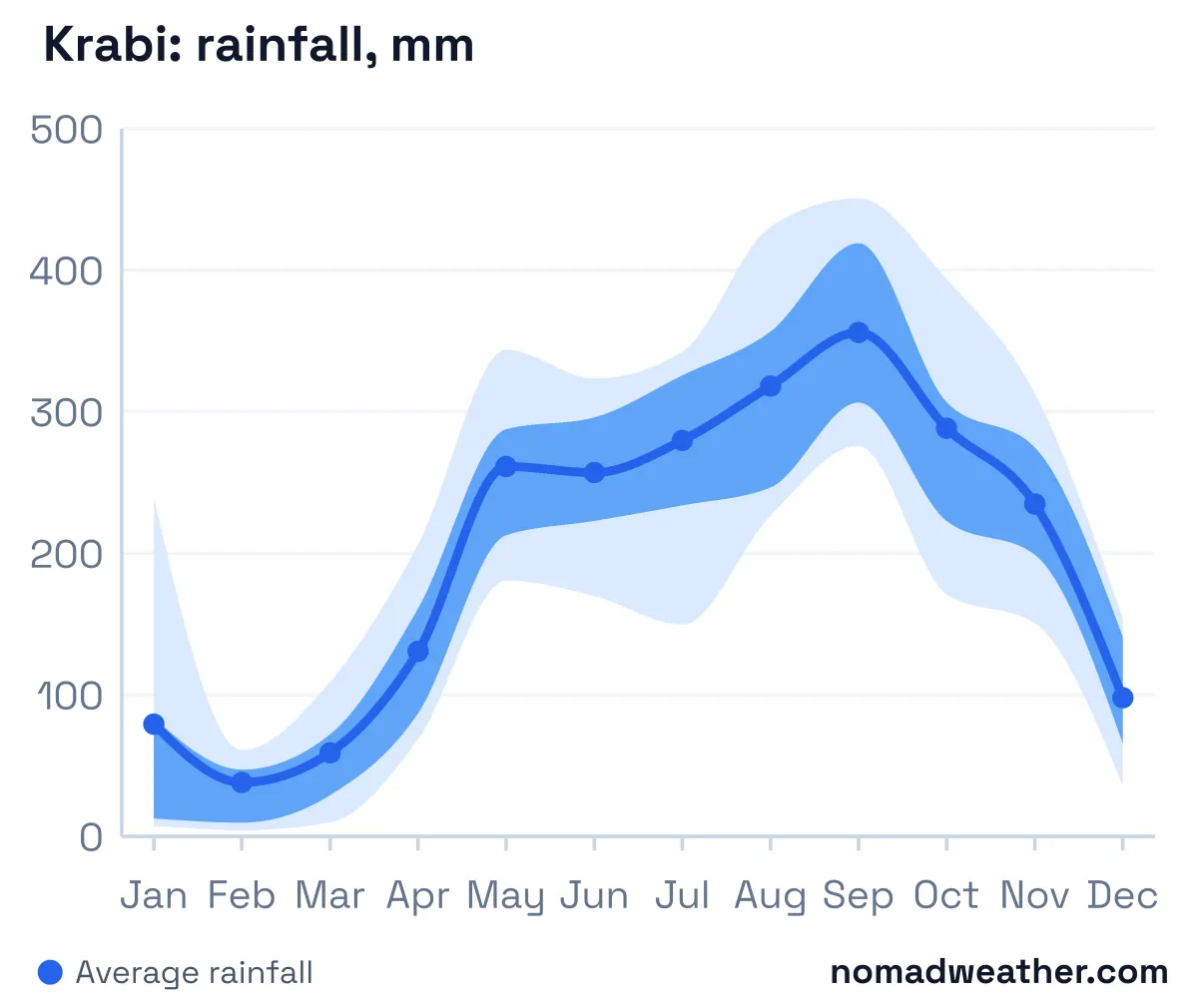
Krabi: Rainfall, mm
Averages 2015-2025 · Source: Open-Meteo, CHIRPS · How we measure
Read the rain line first: little rain from January to March, a step up in April, then a long wet stretch from May to October that peaks at 356 mm in September. The temperature band is flat apart from a bump to 34° in March. For one month at a time, the Krabi page and the Koh Lanta page are faster.
Where to be next: your month-by-month route, $19
A route for your months with a leave-by date for each stop, a backup, and the seasonal traps on your path. Drafted from 11 years of weather data, every number checked against it, in your inbox within 48 hours. Not included: visas, insurance or bookings.
When is the dry season in Krabi and Koh Lanta?
January to March is the clean window, and rain falls on only about 2 to 5 days a month. Krabi has 79, 38 and 59 mm in those months; Koh Lanta has 54, 23 and 43 mm. February is the driest and one of the clearest, with cloud near 57 percent against 86 to 90 percent in the wet months.
The heat builds as the rain falls. Krabi's high goes from 31° in January to 33° in February and 34° in March, its hottest month in our data. Lanta runs a degree or two cooler, with more wind. If you work from a room without good air conditioning, March is the month that tests that.
Is November or December a good time to go?
Not for settled weather. They are shoulder months. November still has 235 mm in Krabi and 200 mm on Lanta, with rain on about 19 and 17 of 30 days. December drops to 98 and 88 mm, with highs of 29° to 30°.
December is the month the travel sites call high season, but it is mixed in our data: wetter than January, with showers still likely. If you arrive for Christmas, expect some grey days and treat the dry run as starting in January. How the three coasts compare in December is in Thailand in December, and what to expect one coast north is in Phuket in November.
What happens in April?
April is the turn. Krabi's high is 33° and its low 25°, humidity climbs to 81 percent and rain jumps to 131 mm (117 mm on Lanta), often as late-afternoon storms rather than all-day rain. It is hot, sticky and still workable. The first big step to the wet season comes in May, with 335 mm on Lanta.
How bad is the green season?
Wet enough to plan around, though not constant. From May to October, Krabi gets 257 to 356 mm a month and Lanta 293 to 406 mm, falling on about 14 to 21 days a month in heavy bursts and long grey spells. Highs are 29° to 31°.
Expect the usual practical effects: the sea is rougher, some boats and island trips are cancelled, and a number of beach places on Lanta shut for part of the season. We hold no swell or boat data, so we cannot say which weeks. Plan on indoor work, flexible days and cheaper rent, and do not count on beach days.
What is different between Krabi town and Koh Lanta?
Less than the brochures suggest: the pattern is the same and the gaps are small and consistent.
February and August averages, side by side
| Place | High | Low | Rain | Rain days |
|---|---|---|---|---|
| Krabi Feb | 33° | 23° | 38 mm | 3 |
| Krabi Aug | 30° | 25° | 318 mm | 16 |
| Ko Lanta Feb | 32° | 25° | 23 mm | 2 |
| Ko Lanta Aug | 29° | 26° | 406 mm | 17 |
Averages 2015-2025 · Source: Open-Meteo, CHIRPS · How we measure
In the dry months Lanta is drier (23 mm against 38 mm in February) and a degree or two cooler. In the wet months it is wetter (406 mm against 318 mm in August). Nights on Lanta are warmer and there is more wind. Both are single points on the map: beaches such as Ao Nang or Railay can differ, and we do not split them. For the wider region, the three coasts of Thailand compared shows when the Gulf side is dry instead.
Which months for a long stay?
February and March are the safe pair: go for these if the dates are fixed. January is nearly as good, with a little more rain (see where is warm in January). December and April are shoulder months, workable if you are flexible. May to October is the green season, fine for a cheap, quiet stay with indoor work. In November, wait a month.
For the whole country in February see where is warm in February. Choosing between Koh Lanta, Phuket, Krabi and Koh Phangan for December to March? See the four side by side. This is a weather view only; it does not cover flights, ferries, rent or internet quality.
How sure are these numbers?
They are month-of-year averages for one point at each place from stored climate data (Open-Meteo archive and CHIRPS rain totals, 2015 to 2025), so any single year can be wetter or drier. Cloud is the average share of sky covered, not hours of sunshine. Other sites quote different figures because they use different stations and years.
Frequently asked questions
What is the best month to visit Krabi?
February. Krabi has 38 mm of rain, a 33°C high and the clearest skies of the year, with January and March close behind. March is a little hotter (34°C) and wetter at 59 mm.
What is the best time to visit Koh Lanta?
February and March. Koh Lanta gets 23 mm in February and 43 mm in March, with highs of 32°C. January is also good at 54 mm.
When is the rainy season in Krabi?
May to October, with rain of 257 to 356 mm a month and cloud over about 88 percent of the sky. September is the wettest at 356 mm. April (131 mm) is the turn, with storms and high humidity.
Is Koh Lanta good in December?
It is a shoulder month. Rain has dropped to 88 mm from 200 mm in November, with a high of 29°C, but it is not as settled as January or February.
Is Koh Lanta wetter than Krabi?
In the wet months, yes slightly: August is 406 mm against 318 mm. In the dry months it is the opposite: 23 mm against 38 mm in February.
Not sure where yet? Pick your months and what to avoid, and get your 3 best places → Where should I go?
Weather data: Open-Meteo (CC BY 4.0), open-meteo.com; rain totals: CHIRPS (Climate Hazards Center, UC Santa Barbara). Processed by NomadWeather from stored copies of the data.